Ch.4 Introduction to Organic Compounds
Frost - General, Organic and Biological Chemistry 4th Edition
Frost4th EditionGeneral, Organic and Biological ChemistryISBN: 9780134988696Non è quello che usi tu?Cambia libro di testo
Capitolo 1, Problema 74

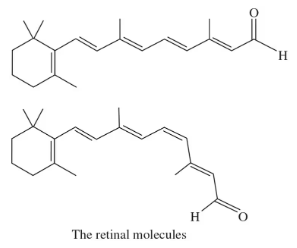
The vision process in animals involves the change of one double bond in retinal from its cis form to its trans form. The structures of cis and trans retinal are shown below. Label which is cis and which is trans.

Guida verificata passo dopo passo
1
Understand the difference between cis and trans isomers: Cis isomers have substituents on the same side of the double bond, while trans isomers have substituents on opposite sides of the double bond.
Examine the structure of the retinal molecules provided in the image. Focus on the double bond in question and the positions of the substituents attached to the carbon atoms of the double bond.
Identify the molecule where the substituents are on the same side of the double bond. This is the cis isomer.
Identify the molecule where the substituents are on opposite sides of the double bond. This is the trans isomer.
Label the structures accordingly: The molecule with substituents on the same side of the double bond is labeled as 'cis,' and the molecule with substituents on opposite sides is labeled as 'trans.'

Risposta video verificata per un problema simile:

Questa soluzione video è stata consigliata dai nostri tutor come utile per risolvere questo problema.
Durata del video:
2m

Concetti chiave

Ecco i concetti essenziali che devi comprendere per rispondere correttamente alla domanda.

Retinal Structure

Retinal is a light-sensitive molecule found in the photoreceptor cells of the retina. It exists in two isomeric forms: cis and trans. The cis form has a bent structure due to a double bond, while the trans form is more linear. This structural difference is crucial for its function in the vision process, as the conversion between these forms initiates the phototransduction cascade.
Video consigliato:
Percorso guidato
1:01
Structural Formula Concept 2

Isomerization

Isomerization refers to the process by which a molecule changes its structure without altering its molecular formula. In the context of retinal, the isomerization from cis to trans occurs when it absorbs light. This change is essential for activating the visual pigments in photoreceptors, leading to the perception of light and color.
Video consigliato:
Percorso guidato
1:26
Glycolysis Concept 5

Phototransduction

Phototransduction is the biochemical process by which light is converted into electrical signals in the retina. When retinal changes from its cis to trans form, it triggers a series of reactions involving proteins like opsins. This cascade ultimately results in the hyperpolarization of photoreceptor cells, allowing the brain to interpret visual information.