Ch.5 Chemical Reactions
Frost - General, Organic and Biological Chemistry 4th Edition
Frost4th EditionGeneral, Organic and Biological ChemistryISBN: 9780134988696Non è quello che usi tu?Cambia libro di testo
Capitolo 2, Problema 57b

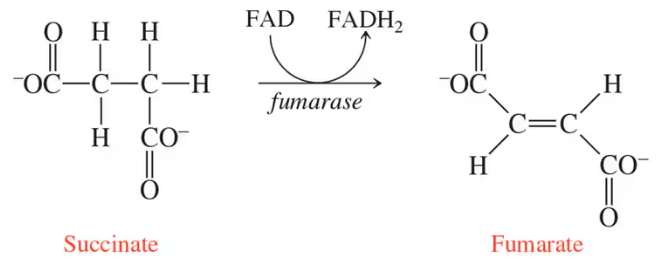
Identify the main organic reaction shown as condensation, hydrolysis, oxidation, or reduction:
(b)

Guida verificata passo dopo passo
1
Examine the reaction carefully to identify the functional groups involved in the reactants and products. Look for changes such as the formation or breaking of bonds, addition or removal of atoms, or changes in oxidation states.
Determine if the reaction involves the combination of two molecules with the loss of a small molecule (e.g., water). If so, it is a condensation reaction.
Check if the reaction involves the breaking of a larger molecule into smaller molecules with the addition of water. If so, it is a hydrolysis reaction.
Analyze if the reaction involves the gain of oxygen or the loss of hydrogen. If so, it is an oxidation reaction.
Analyze if the reaction involves the gain of hydrogen or the loss of oxygen. If so, it is a reduction reaction.

Risposta video verificata per un problema simile:

Questa soluzione video è stata consigliata dai nostri tutor come utile per risolvere questo problema.
Durata del video:
2m

Concetti chiave

Ecco i concetti essenziali che devi comprendere per rispondere correttamente alla domanda.

Condensation Reaction

A condensation reaction is a chemical process where two molecules combine to form a larger molecule, releasing a small molecule, often water, as a byproduct. This type of reaction is crucial in the formation of polymers and complex biomolecules, such as proteins and nucleic acids, from simpler monomers.
Video consigliato:
Percorso guidato
1:53
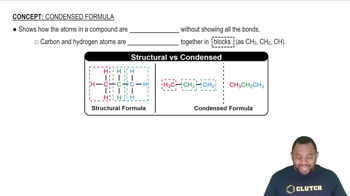
Condensed Formula Concept 1

Hydrolysis Reaction

Hydrolysis is the chemical breakdown of a compound due to reaction with water. In biological systems, hydrolysis is essential for digestion, as it helps break down complex carbohydrates, proteins, and lipids into their monomeric units, making them accessible for absorption and utilization by the body.
Video consigliato:
Percorso guidato
3:09
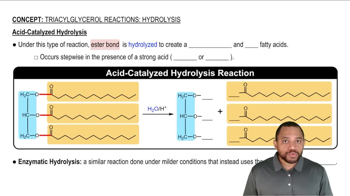
Triacylglycerol Reactions: Hydrolysis Concept 1

Oxidation-Reduction (Redox) Reactions

Oxidation-reduction reactions, or redox reactions, involve the transfer of electrons between two substances. Oxidation refers to the loss of electrons, while reduction refers to the gain of electrons. These reactions are fundamental in metabolic processes, such as cellular respiration, where energy is produced through the oxidation of glucose.
Video consigliato:
Percorso guidato
01:53
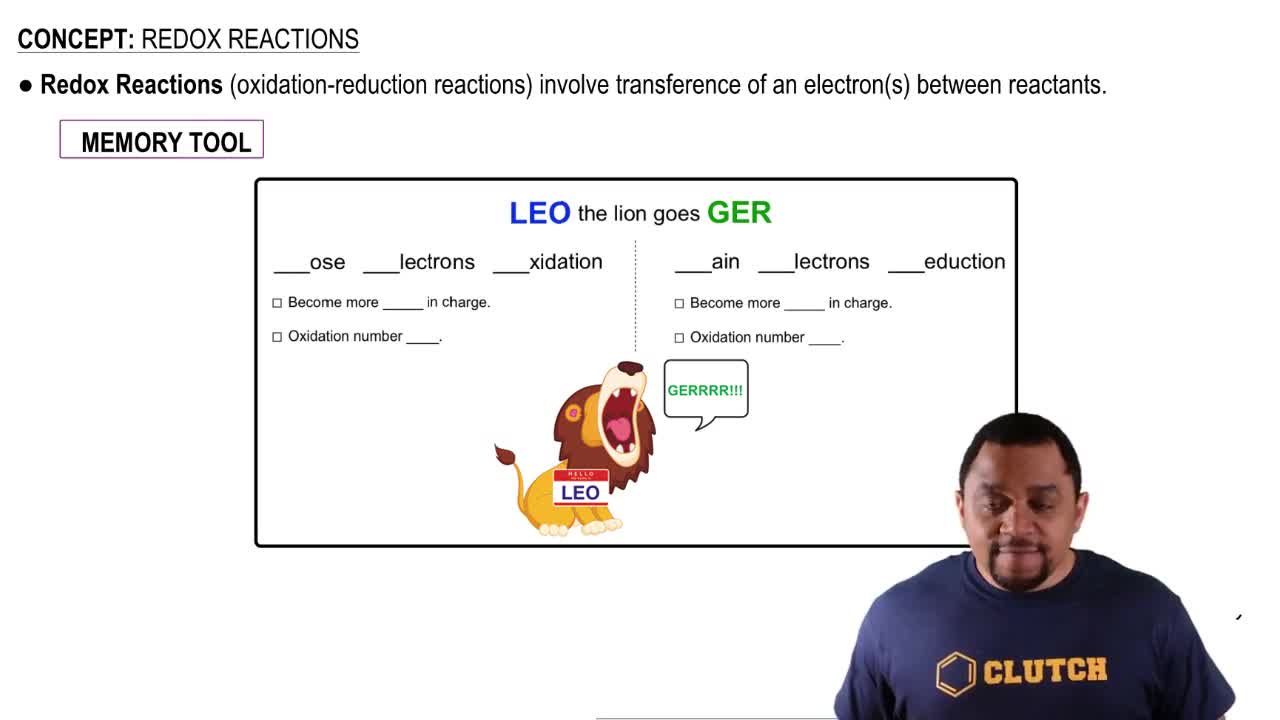
Redox Reactions