Ch.5 Chemical Reactions
Frost - General, Organic and Biological Chemistry 4th Edition
Frost4th EditionGeneral, Organic and Biological ChemistryISBN: 9780134988696Non è quello che usi tu?Cambia libro di testo
Capitolo 2, Problema 74a

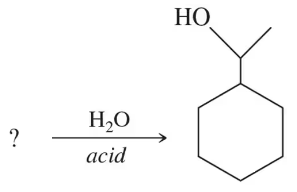
Fill in the missing organic product or reactant for the following hydration reactions:
(a)

Guida verificata passo dopo passo
1
Identify the type of reaction: This is a hydration reaction, which typically involves the addition of water (H₂O) to an alkene to form an alcohol.
Determine the reactants and products: In a hydration reaction, the alkene reacts with water in the presence of an acid catalyst (e.g., H⁺) to form an alcohol. The double bond in the alkene breaks, and the -OH group attaches to one carbon, while the -H attaches to the other.
Apply Markovnikov's rule: In most hydration reactions, the -OH group will attach to the more substituted carbon (the carbon with more alkyl groups), while the -H will attach to the less substituted carbon.
Draw the structure of the product: Break the double bond in the alkene and add the -OH group to the appropriate carbon based on Markovnikov's rule. Ensure the resulting structure is a valid alcohol.
Verify the reaction conditions: Confirm that the reaction conditions (e.g., presence of an acid catalyst) are consistent with the hydration mechanism and that the product is correctly formed.

Risposta video verificata per un problema simile:

Questa soluzione video è stata consigliata dai nostri tutor come utile per risolvere questo problema.
Durata del video:
2m

Concetti chiave

Ecco i concetti essenziali che devi comprendere per rispondere correttamente alla domanda.

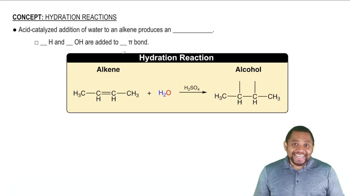
Hydration Reactions

Hydration reactions involve the addition of water to a compound, typically an alkene, resulting in the formation of alcohols. This process is crucial in organic chemistry as it transforms unsaturated hydrocarbons into more functionalized products. Understanding the mechanism of hydration, including the role of catalysts and the conditions required, is essential for predicting the products of these reactions.
Video consigliato:
Percorso guidato
1:25
Symmetric Alkene Hydration Concept 1

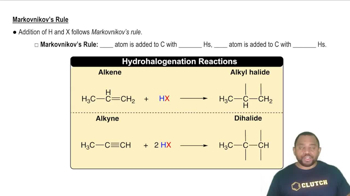
Markovnikov's Rule

Markovnikov's Rule states that in the addition of HX (where X is a halogen or OH) to an alkene, the hydrogen atom will attach to the carbon with the greater number of hydrogen atoms already attached. This principle helps predict the major product of hydration reactions, guiding chemists in determining the structure of the resulting alcohol. Recognizing this rule is vital for accurately filling in missing reactants or products in hydration equations.
Video consigliato:
Percorso guidato
1:37
Markovnikov's Rule Concept 2

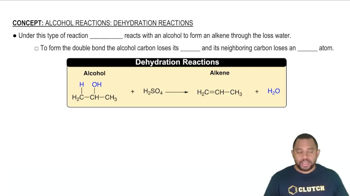
Reaction Mechanism

A reaction mechanism outlines the step-by-step sequence of elementary reactions that occur during a chemical transformation. In hydration reactions, understanding the mechanism helps in identifying intermediates, such as carbocations, and the overall pathway from reactants to products. This knowledge is crucial for predicting reaction outcomes and for designing synthetic routes in organic chemistry.
Video consigliato:
Percorso guidato
1:30
Alcohol Reactions: Dehydration Reactions Concept 1