Ch.5 Chemical Reactions
Frost - General, Organic and Biological Chemistry 4th Edition
Frost4th EditionGeneral, Organic and Biological ChemistryISBN: 9780134988696Non è quello che usi tu?Cambia libro di testo
Capitolo 2, Problema 69a

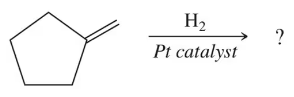
Fill in the missing organic products or reactants for the following hydrogenation reactions:
(a)

Guida verificata passo dopo passo
1
Identify the type of reaction: Hydrogenation is a reaction where hydrogen (H₂) is added to an organic compound, typically involving the reduction of a double or triple bond to a single bond.
Determine the reactant: In hydrogenation, the reactant is usually an alkene (a compound with a carbon-carbon double bond) or an alkyne (a compound with a carbon-carbon triple bond). Analyze the structure of the given reactant in the image to confirm this.
Determine the product: The addition of hydrogen across the double or triple bond will result in the formation of an alkane (a compound with only single bonds between carbons). For example, if the reactant is an alkene, the double bond will be reduced to a single bond, and two hydrogen atoms will be added to the carbons that were part of the double bond.
Write the balanced chemical equation: Represent the reaction using a chemical equation. For example, if the reactant is ethene (C₂H₄), the equation would be: C24+H2→C2H6.
Verify the reaction conditions: Hydrogenation reactions typically require a catalyst, such as platinum (Pt), palladium (Pd), or nickel (Ni), and are carried out under specific conditions of temperature and pressure. Ensure these are included in the reaction setup.

Risposta video verificata per un problema simile:

Questa soluzione video è stata consigliata dai nostri tutor come utile per risolvere questo problema.
Durata del video:
2m

Concetti chiave

Ecco i concetti essenziali che devi comprendere per rispondere correttamente alla domanda.

Hydrogenation

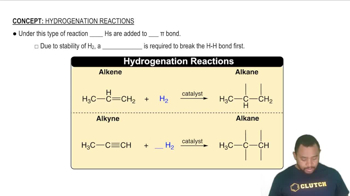
Hydrogenation is a chemical reaction that involves the addition of hydrogen (H2) to an unsaturated organic compound, typically alkenes or alkynes, converting them into saturated hydrocarbons. This process is commonly used in the food industry to convert liquid vegetable oils into solid fats, as well as in the petrochemical industry to refine crude oil.
Video consigliato:
Percorso guidato
1:22
Hydrogenation Reactions Concept 1

Reactants and Products

In a chemical reaction, reactants are the starting materials that undergo transformation, while products are the substances formed as a result of the reaction. Understanding the specific reactants and products involved in hydrogenation is crucial for predicting the outcome of the reaction and for balancing chemical equations.
Video consigliato:
Percorso guidato
01:37
Solubility Product Constant (Ksp) Concept 2

Catalysts in Hydrogenation

Catalysts are substances that increase the rate of a chemical reaction without being consumed in the process. In hydrogenation reactions, metal catalysts such as palladium, platinum, or nickel are often used to facilitate the addition of hydrogen to the unsaturated compounds, making the reaction more efficient and selective.
Video consigliato:
Percorso guidato
1:22
Hydrogenation Reactions Concept 1