Ch.6 Carbohydrates Life's Sweet Molecules
Frost - General, Organic and Biological Chemistry 4th Edition
Frost4th EditionGeneral, Organic and Biological ChemistryISBN: 9780134988696Non è quello che usi tu?Cambia libro di testo
Capitolo 3, Problema 87

On an exam, a student was asked to draw the Fischer projection of L-glucose, but he had only memorized the structure of D-glucose. He wrote the structure of D-glucose and switched the hydroxyl group on C5 from the right to the left. Was his answer correct? If not, what is the name of the aldose that he drew?

Guida verificata passo dopo passo
1
Understand the difference between D- and L- configurations: The D- and L- designations in sugars refer to the configuration of the chiral carbon furthest from the carbonyl group (C=O). In D-glucose, the hydroxyl group (-OH) on the last chiral carbon (C5) is on the right in the Fischer projection, while in L-glucose, it is on the left.
Analyze the student's approach: The student switched the hydroxyl group on C5 from the right to the left, which is consistent with the L-configuration. However, the configuration of all other chiral carbons (C2, C3, and C4) must also be inverted to correctly represent L-glucose.
Check the structure drawn: If the student only switched the hydroxyl group on C5 and left the configurations of C2, C3, and C4 unchanged, the resulting structure is not L-glucose. Instead, it represents a different sugar with a specific name.
Identify the sugar: The sugar drawn by the student is the enantiomer of D-glucose, which is called D-mannose. This occurs because switching the hydroxyl group on C5 alone does not invert the entire molecule to the L-configuration.
Conclude the answer: The student's answer was incorrect. To correctly draw L-glucose, the configurations of all chiral carbons (C2, C3, C4, and C5) must be inverted relative to D-glucose.

Risposta video verificata per un problema simile:

Questa soluzione video è stata consigliata dai nostri tutor come utile per risolvere questo problema.
Durata del video:
3m

Concetti chiave

Ecco i concetti essenziali che devi comprendere per rispondere correttamente alla domanda.

Fischer Projection

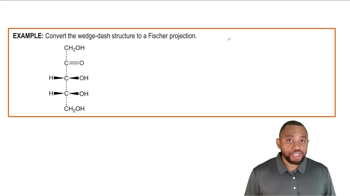
The Fischer projection is a two-dimensional representation of a molecule, particularly useful for depicting the stereochemistry of carbohydrates. In this format, the vertical lines represent bonds that project behind the plane of the page, while horizontal lines represent bonds that project out towards the viewer. This method is essential for visualizing the spatial arrangement of atoms in sugars, allowing for easy identification of stereoisomers.
Video consigliato:
Percorso guidato
0:48
Fischer Projections Example 1

D- and L- Configuration

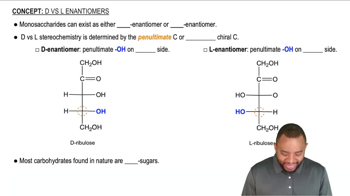
The D- and L- designations refer to the configuration of the chiral carbon furthest from the aldehyde or ketone group in a sugar molecule. In the case of glucose, D-glucose has the hydroxyl group on the right at this carbon, while L-glucose has it on the left. This distinction is crucial for understanding the stereochemistry of sugars and their biological roles, as D- and L- forms can have different properties and functions.
Video consigliato:
Percorso guidato
1:30
D vs L Enantiomers Concept 1

Aldose

An aldose is a type of sugar (monosaccharide) that contains an aldehyde group (-CHO) at one end of the molecule. Glucose is a common example of an aldose. When the student incorrectly modified D-glucose, he inadvertently created a different aldose, specifically D-mannose, by switching the hydroxyl group on C5. Understanding the classification of sugars as aldoses or ketoses is fundamental in carbohydrate chemistry.
Video consigliato:
Percorso guidato
0:39
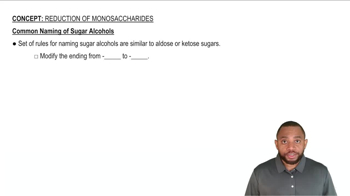
Common Naming of Sugar Alcohols Concept 3
Pratica correlata
Domanda del libro di testo

The structure of sucralose, found in the artificial sweetener Splenda, is shown in the figure. It consists of a chlorinated disaccharide made up of galactose and fructose. In its structure shown, (b) identify the type of glycosidic bond present.

56
views
Domanda del libro di testo

Carbohydrates are abbreviated using a three-letter abbreviation followed by their glycosidic bond type. For example, maltose and sucrose can be written respectively as

Provide the structure for the O-type blood carbohydrate set given the following abbreviation:

L-Fucα (1→2) Galß(1→4)GlcNAc

705
views
Domanda del libro di testo

The structure of sucralose, found in the artificial sweetener Splenda, is shown in the figure. It consists of a chlorinated disaccharide made up of galactose and fructose. In its structure shown,

(a) identify the galactose unit and the fructose unit.

1290
views
Domanda del libro di testo

Our bodies cannot digest cellulose because we lack the enzyme cellulase. Why is cellulose an important part of a healthy diet if we cannot digest it?

663
views
Domanda del libro di testo

Glycogen and amylopectin are both branched polymers of glucose. Read the descriptions of each in Section 6.6. Which molecule has a more compact structure? Explain.

1077
views
Domanda del libro di testo

The shell of a shrimp is composed of chitin. If you eat a boiled shrimp without removing the shell, will your body break the shell down into its component sugars? Explain. (Hint: Compare chitin’s structure to that of amylose and cellulose.)

881
views