Ch.6 Carbohydrates Life's Sweet Molecules
Frost - General, Organic and Biological Chemistry 4th Edition
Frost4th EditionGeneral, Organic and Biological ChemistryISBN: 9780134988696Non è quello che usi tu?Cambia libro di testo
Capitolo 3, Problema 31

Pentoses also exist in a ring form, but they most commonly occur as furanose rings. D-Ribose exists in its furanose ring form in the nucleic acid RNA. Using the structure of D-ribose from Table 6.1, draw the furanose form of β-D-ribose.

Guida verificata passo dopo passo
1
Identify the linear structure of d-ribose from Table 6.1. d-Ribose is a pentose sugar with five carbon atoms, where the aldehyde group is at the first carbon and hydroxyl groups are attached to the other carbons.
Understand that the furanose form of d-ribose is a cyclic structure formed by the reaction of the aldehyde group at C1 with the hydroxyl group at C4, creating a five-membered ring (furanose).
Determine the stereochemistry of ß-d-ribose. In the ß-anomer, the hydroxyl group on the anomeric carbon (C1) is positioned above the plane of the ring in a Haworth projection.
Draw the furanose ring structure. Start by sketching a five-membered ring with oxygen as one of the vertices. Place the carbon atoms (C1 to C5) appropriately, ensuring the correct connectivity and stereochemistry.
Add the substituents to the ring. Place the hydroxyl groups and hydrogen atoms on the carbons according to the stereochemistry of ß-d-ribose, ensuring the hydroxyl group on C1 is above the plane of the ring.

Risposta video verificata per un problema simile:

Questa soluzione video è stata consigliata dai nostri tutor come utile per risolvere questo problema.
Durata del video:
6m

Concetti chiave

Ecco i concetti essenziali che devi comprendere per rispondere correttamente alla domanda.

Furanose Structure

Furanose refers to a five-membered ring structure formed by the cyclization of pentose sugars, such as d-ribose. In this configuration, one of the carbons in the sugar forms a bond with the oxygen atom, creating a stable cyclic form. This structure is significant in biochemistry, particularly in nucleic acids, as it influences the sugar's reactivity and interactions.
Video consigliato:
Percorso guidato
1:01
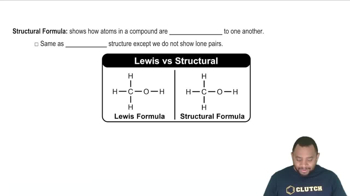
Structural Formula Concept 2

d-Ribose

d-Ribose is a naturally occurring sugar that is a crucial component of RNA (ribonucleic acid). It is a pentose sugar, meaning it contains five carbon atoms, and its specific configuration allows it to participate in the formation of nucleotides, which are the building blocks of RNA. Understanding its structure is essential for grasping how genetic information is stored and transmitted.
Video consigliato:
Percorso guidato
1:30
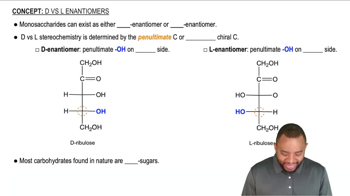
D vs L Enantiomers Concept 1

Beta Anomer

The term 'beta' in carbohydrate chemistry refers to the configuration of the hydroxyl group on the anomeric carbon in a cyclic sugar. In the case of ß-d-ribose, the hydroxyl group on the anomeric carbon (C1) is positioned above the plane of the ring. This distinction is important because it affects the sugar's properties and its interactions with other biomolecules, influencing the overall structure of RNA.
Video consigliato:
Percorso guidato
02:32
Characteristics of Beta Particles