Ch.6 Carbohydrates Life's Sweet Molecules
Frost - General, Organic and Biological Chemistry 4th Edition
Frost4th EditionGeneral, Organic and Biological ChemistryISBN: 9780134988696Non è quello che usi tu?Cambia libro di testo
Capitolo 3, Problema 75b

Will the following carbohydrates produce a positive Benedict’s test?
b. lactose

Guida verificata passo dopo passo
1
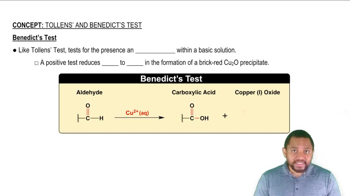
Understand the Benedict's test: The Benedict's test is used to identify reducing sugars. Reducing sugars are carbohydrates that have a free aldehyde group (-CHO) or a free ketone group (-C=O) that can reduce copper(II) ions (Cu²⁺) in Benedict's reagent to copper(I) oxide (Cu₂O), forming a red precipitate.
Determine the structure of lactose: Lactose is a disaccharide composed of glucose and galactose linked by a β-1,4-glycosidic bond. It is important to note that one of the monosaccharide units in lactose has a free aldehyde group when the glycosidic bond is hydrolyzed.
Analyze lactose as a reducing sugar: Lactose is classified as a reducing sugar because it contains a hemiacetal group in its structure. This hemiacetal group can open up to form a free aldehyde group under the conditions of the Benedict's test.
Relate the chemical behavior of lactose to the Benedict's test: Since lactose can produce a free aldehyde group, it will react with Benedict's reagent, reducing Cu²⁺ to Cu₂O and producing a positive result (red precipitate).
Conclude the result: Based on the chemical properties of lactose and its ability to act as a reducing sugar, lactose will produce a positive Benedict's test.

Risposta video verificata per un problema simile:

Questa soluzione video è stata consigliata dai nostri tutor come utile per risolvere questo problema.
Durata del video:
3m

Concetti chiave

Ecco i concetti essenziali che devi comprendere per rispondere correttamente alla domanda.

Benedict's Test

Benedict's test is a qualitative assay used to detect reducing sugars in a solution. When a reducing sugar is present, the copper(II) ions in the Benedict's reagent are reduced to copper(I) oxide, resulting in a color change that can range from green to brick red, depending on the concentration of the sugar. This test is commonly used in biochemistry to identify sugars like glucose and fructose.
Video consigliato:
Percorso guidato
1:19
Benedict's Test Concept 3

Reducing Sugars

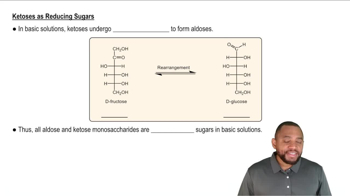
Reducing sugars are carbohydrates that can donate electrons to other molecules, thus reducing them. This property is due to the presence of a free aldehyde or ketone group in their structure. Common examples include monosaccharides like glucose and disaccharides like lactose, which can act as reducing agents under certain conditions.
Video consigliato:
Percorso guidato
1:03
Ketoses as Reducing Sugars Concept 2

Lactose

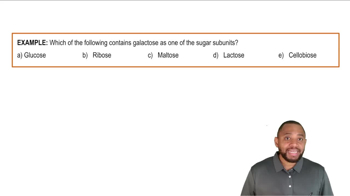
Lactose is a disaccharide sugar composed of glucose and galactose, commonly found in milk. It is classified as a reducing sugar because it has a free aldehyde group that can participate in redox reactions. Therefore, lactose can produce a positive result in a Benedict's test, indicating its reducing properties.
Video consigliato:
Percorso guidato
0:50
Types of Disaccharides Example 1