
Ch.1 Matter and Measurements
McMurry - Fundamentals of General, Organic, and Biological Chemistry 8th Edition
McMurry8th EditionFundamentals of General, Organic, and Biological ChemistryISBN: 9780134015187Non è quello che usi tu?Cambia libro di testo
Capitolo 1, Problema 82

Calculate the specific heat of copper if it takes 23 cal (96 J) to heat a 5.0 g sample from 25 °C to 75 °C.

Guida verificata passo dopo passo
1
Step 1: Recall the formula for specific heat: c = rac{q}{m imes riangle T}, where c is the specific heat, q is the heat energy, m is the mass, and riangle T is the change in temperature.
Step 2: Calculate the temperature change, riangle T, using the formula riangle T = T_{\(\text{final}\)} - T_{\(\text{initial}\)}. Substitute the given values: T_{\(\text{final}\)} = 75 \(\text{ °C}\) and T_{\(\text{initial}\)} = 25 \(\text{ °C}\).
Step 3: Substitute the given values into the formula for specific heat. Use q = 23 \(\text{ cal}\), m = 5.0 \(\text{ g}\), and the calculated riangle T from Step 2.
Step 4: Perform the division to calculate the specific heat, ensuring the units are consistent. Since the heat energy is given in calories, the specific heat will be in units of \(\text{cal/g·°C}\).
Step 5: If needed, convert the specific heat to other units (e.g., \(\text{J/g·°C}\)) using the conversion factor 1 \(\text{ cal}\) = 4.184 \(\text{ J}\).

Risposta video verificata per un problema simile:

Questa soluzione video è stata consigliata dai nostri tutor come utile per risolvere questo problema.
Durata del video:
1m

Concetti chiave

Ecco i concetti essenziali che devi comprendere per rispondere correttamente alla domanda.

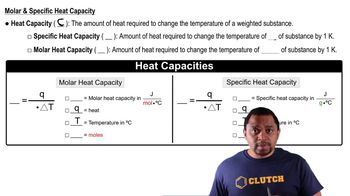
Specific Heat Capacity

Specific heat capacity is the amount of heat required to raise the temperature of a unit mass of a substance by one degree Celsius. It is a material-specific property that indicates how much energy is needed to change the temperature of a given mass, which is crucial for calculations involving heat transfer.
Video consigliato:

Heat Transfer

Heat transfer refers to the movement of thermal energy from one object or substance to another due to a temperature difference. In this context, it is essential to understand how heat energy is absorbed or released by the copper sample as it is heated, which directly relates to the specific heat capacity.
Video consigliato:

Calorimetry

Calorimetry is the science of measuring the heat of chemical reactions or physical changes. In this problem, calorimetry principles are applied to determine the specific heat of copper by measuring the heat energy supplied to the sample and the resulting temperature change.