
Ch.1 Matter and Measurements
McMurry - Fundamentals of General, Organic, and Biological Chemistry 8th Edition
McMurry8th EditionFundamentals of General, Organic, and Biological ChemistryISBN: 9780134015187Non è quello che usi tu?Cambia libro di testo
Capitolo 1, Problema 83

The specific heat of fat is 0.45 cal/(g ⋅ °C) (1.9 J/g °C) and the density of fat is 0.94 g/cm3. How much energy (in calories and joules) is needed to heat 10 cm3 of fat from room temperature (25 °C) to its melting point (35 °C)?

Guida verificata passo dopo passo
1
Step 1: Identify the formula for calculating the energy required to heat a substance. The formula is: Q = m × c × ΔT, where Q is the heat energy, m is the mass, c is the specific heat capacity, and ΔT is the change in temperature.
Step 2: Calculate the mass of the fat using its density and volume. The formula for mass is: m = density × volume. Given the density of fat is 0.94 g/cm³ and the volume is 10 cm³, substitute these values into the formula.
Step 3: Determine the temperature change (ΔT). Subtract the initial temperature (25 °C) from the final temperature (35 °C): ΔT = 35 °C - 25 °C.
Step 4: Substitute the values for mass (from Step 2), specific heat capacity (c = 0.45 cal/(g⋅°C) or 1.9 J/(g⋅°C)), and ΔT (from Step 3) into the formula Q = m × c × ΔT. Perform the calculation separately for calories and joules.
Step 5: Report the energy required in both calories and joules. Ensure the units are consistent and clearly labeled for each result.

Risposta video verificata per un problema simile:

Questa soluzione video è stata consigliata dai nostri tutor come utile per risolvere questo problema.
Durata del video:
2m

Concetti chiave

Ecco i concetti essenziali che devi comprendere per rispondere correttamente alla domanda.

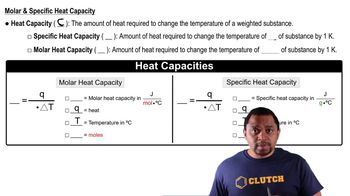
Specific Heat Capacity

Specific heat capacity is the amount of heat energy required to raise the temperature of a unit mass of a substance by one degree Celsius. In this case, the specific heat of fat is given as 0.45 cal/(g ⋅ °C) or 1.9 J/g °C, indicating how much energy is needed to increase the temperature of fat. Understanding this concept is crucial for calculating the energy required to heat the fat.
Video consigliato:

Density

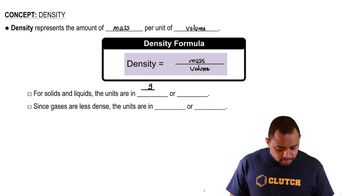
Density is defined as mass per unit volume and is a key property of materials. The density of fat is provided as 0.94 g/cm³, which allows us to determine the mass of the fat when its volume is known. This relationship is essential for converting volume measurements into mass, which is necessary for energy calculations involving specific heat.
Video consigliato:

Energy Calculation

Energy calculation in this context involves using the formula Q = mcΔT, where Q is the heat energy, m is the mass, c is the specific heat capacity, and ΔT is the change in temperature. To find the energy needed to heat the fat from 25°C to 35°C, we must first calculate the mass of the fat using its density and volume, then apply the specific heat capacity to find the total energy required in both calories and joules.
Video consigliato:
Pratica correlata
Domanda del libro di testo

The white blood cell concentration in normal blood is approximately 12,000 cells/mm3 of blood. How many white blood cells does a normal adult with 5 L of blood have? Express the answer in scientific notation.

2271
views
1
rank
Domanda del libro di testo

Give the full name of the following units:

a. cc

b. dm

c. mm

d. nL

e. mg

f. m3

2062
views
Domanda del libro di testo

When 100 cal (418 J) of heat is applied to a 125 g sample, the temperature increases by 28 °C. Calculate the specific heat of the sample and compare your answer to the values in Table 1.10. What is the identity of the sample?

2109
views
Domanda del libro di testo

A white solid with a melting point of 730 °C is melted. When electricity is passed through the resultant liquid, a brown gas and a molten metal are produced. Neither the metal nor the gas can be broken down into anything simpler by chemical means. Classify each—the white solid, the molten metal, and the brown gas—as a mixture, a compound, or an element.

2158
views
Domanda del libro di testo

Refer to the pencil in Problem 1.31. Using the equivalent values in Table 1.8 as conversion factors, convert the length measured in inches to centimeters. Compare the calculated length in centimeters to the length in centimeters measured using the metric ruler. How do the two values compare? Explain any differences.

<IMAGE>

1865
views
Domanda del libro di testo

Calculate the specific heat of copper if it takes 23 cal (96 J) to heat a 5.0 g sample from 25 °C to 75 °C.

2295
views