

Ch.8 Gases, Liquids and Solids
McMurry - Fundamentals of General, Organic, and Biological Chemistry 8th Edition
McMurry8th EditionFundamentals of General, Organic, and Biological ChemistryISBN: 9780134015187Non è quello che usi tu?Cambia libro di testo
Capitolo 8, Problema 7

A local weather station reports the barometric pressure as 29.5 inHg (inches of Hg). Convert this pressure to torr and to atm.

Guida verificata passo dopo passo
1
Step 1: Understand the problem. The goal is to convert the given pressure of 29.5 inHg (inches of mercury) into two different units: torr and atm (atmospheres). To do this, we need the appropriate conversion factors.
Step 2: Recall the conversion factors. The relationships between the units are as follows: 1 inHg = 25.4 mmHg (millimeters of mercury), and 1 mmHg = 1 torr. Additionally, 1 atm = 760 torr.
Step 3: Convert inches of mercury (inHg) to torr. First, use the conversion factor 1 inHg = 25.4 mmHg to convert 29.5 inHg to mmHg. Then, since 1 mmHg = 1 torr, the value in mmHg will be numerically equal to the value in torr. Use the formula: \( \text{Pressure in torr} = \text{Pressure in inHg} \times 25.4 \).
Step 4: Convert torr to atm. Use the conversion factor 1 atm = 760 torr. Divide the pressure in torr by 760 to find the pressure in atm. Use the formula: \( \text{Pressure in atm} = \frac{\text{Pressure in torr}}{760} \).
Step 5: Summarize the process. You have now converted the pressure from inHg to torr and then from torr to atm using the appropriate conversion factors. Ensure all units are properly labeled in your final answers.

Risposta video verificata per un problema simile:

Questa soluzione video è stata consigliata dai nostri tutor come utile per risolvere questo problema.
Durata del video:
1m

Concetti chiave

Ecco i concetti essenziali che devi comprendere per rispondere correttamente alla domanda.

Barometric Pressure

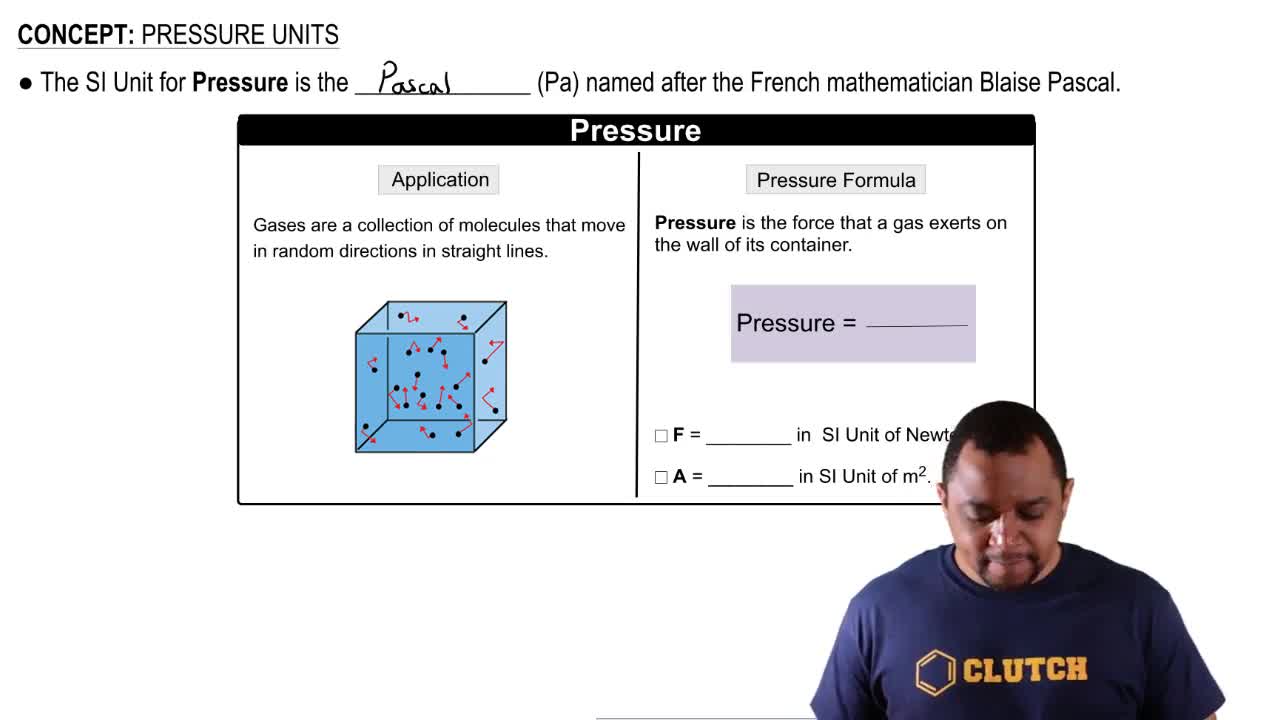
Barometric pressure is the pressure exerted by the weight of the atmosphere at a given point. It is commonly measured in units such as inches of mercury (inHg), torr, and atmospheres (atm). Understanding barometric pressure is essential for meteorology and various scientific applications, as it influences weather patterns and altitude measurements.
Video consigliato:
Percorso guidato
01:15
Pressure Units Concept 1

Unit Conversion

Unit conversion is the process of converting a quantity expressed in one set of units to another. In this context, converting barometric pressure from inches of mercury to torr and atmospheres requires knowledge of the relationships between these units. For example, 1 inHg is equivalent to 25.4 torr and approximately 0.968 atm, which are crucial for accurate scientific communication.
Video consigliato:
Percorso guidato
01:56
Conversion Factors (Simplified) Concept 1

Torr and Atmosphere

Torr and atmosphere (atm) are both units of pressure. The torr is defined as 1/760 of an atmosphere, making it a convenient unit for measuring low pressures, such as those found in weather reports. Understanding these units is important for interpreting pressure readings and performing calculations in various scientific fields, including physics and engineering.
Video consigliato:
Percorso guidato
02:09
Dalton's Law: Partial Pressure (Simplified) Example 1
Pratica correlata
Domanda del libro di testo

Assume that you have a sample of gas at 350 K in a sealed container, as represented in part (a). Which of the drawings (b)–(d) represents the gas after the temperature is lowered from 350 K to 150 K and if the gas has a boiling point of 200 K? Which drawing represents the gas at 150 K if the gas has a boiling point of 100 K?

<IMAGE>

1816
views
Domanda del libro di testo

Determine the percent composition of air in the lungs from the following composition in partial pressures: PN2= 573 mmHg, PO2 = 100 mmHg, PCO2 = 40 mmHg, and PH2O = 47 mmHg; all at 37 °C and 1 atm pressure.

2094
views
Domanda del libro di testo

The change of state from liquid H2O to gaseous H2O has ∆H = +9.72 kcal/mol(+40.7 kJ/mol) and ∆S = -26.1 cal/(mol • K) [-109 J/(mol •K)].

a. Is the change from liquid to gaseous H2O favored or unfavored by ∆H? By ∆S?

1479
views
Domanda del libro di testo

Would you expect the boiling points to increase or decrease in the following series? Explain.

a. Kr, Ar, Ne

1698
views
Domanda del libro di testo

Compare the ∆Hvap values for water, isopropyl alcohol, ether, and ammonia, and order them from lowest to highest. Explain the rank order based on intermolecular attractive forces.

1766
views
Domanda del libro di testo

The change of state from liquid H2O to gaseous H2O has ∆H = +9.72 kcal/mol(+40.7 kJ/mol) and ∆S = -26.1 cal/(mol • K) [-109 J/(mol •K)].

b. What are the values of ∆H and ∆S (in kcal/mol and kJ/mol) for the change from gaseous to liquid H2O?

1545
views