
Ch.18 Amino Acids and Proteins
McMurry - Fundamentals of General, Organic, and Biological Chemistry 8th Edition
McMurry8th EditionFundamentals of General, Organic, and Biological ChemistryISBN: 9780134015187Non è quello che usi tu?Cambia libro di testo
Capitolo 18, Problema 101

Four of the most abundant amino acids in proteins are leucine, alanine, glycine, and valine. What do these amino acids have in common? Would you expect these amino acids to be found on the interior or on the exterior of the protein?

Guida verificata passo dopo passo
1
Step 1: Recognize that leucine, alanine, glycine, and valine are amino acids with nonpolar side chains. Nonpolar side chains are hydrophobic, meaning they do not interact favorably with water.
Step 2: Understand that proteins are composed of amino acids, and their structure is influenced by the chemical properties of these amino acids. Hydrophobic (nonpolar) amino acids tend to avoid water and are often found in the interior of proteins.
Step 3: Recall that the interior of a protein is typically a hydrophobic environment, while the exterior is exposed to the aqueous (water-based) environment of the cell or body. Hydrophilic (polar) amino acids are more likely to be found on the exterior.
Step 4: Conclude that leucine, alanine, glycine, and valine, being nonpolar and hydrophobic, are more likely to be found in the interior of the protein, where they are shielded from water.
Step 5: Note that the placement of these amino acids in the protein structure contributes to the protein's stability and function, as the hydrophobic interactions in the interior help maintain the protein's three-dimensional shape.

Risposta video verificata per un problema simile:

Questa soluzione video è stata consigliata dai nostri tutor come utile per risolvere questo problema.

Concetti chiave

Ecco i concetti essenziali che devi comprendere per rispondere correttamente alla domanda.

Amino Acid Properties

Amino acids are organic compounds that serve as the building blocks of proteins. They have distinct properties based on their side chains, which can be polar, nonpolar, acidic, or basic. Leucine, alanine, glycine, and valine are classified as nonpolar or hydrophobic amino acids, meaning they tend to avoid water and are often found in the interior of proteins, contributing to the protein's overall structure.
Video consigliato:
Percorso guidato
3:03
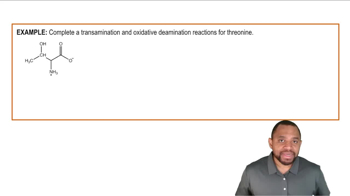
Amino Acid Catabolism: Amino Group Example 2

Protein Structure

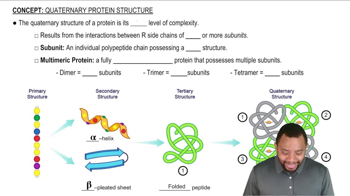
Proteins have a complex structure that is organized into four levels: primary, secondary, tertiary, and quaternary. The arrangement of amino acids influences how a protein folds and its final shape. Nonpolar amino acids like leucine, alanine, glycine, and valine typically cluster in the interior of proteins, stabilizing the structure through hydrophobic interactions.
Video consigliato:
Percorso guidato
3:26
Quaternary Protein Structure Concept 1

Hydrophobic Effect

The hydrophobic effect is a key driving force in protein folding, where nonpolar side chains aggregate away from water to minimize their exposure. This phenomenon helps stabilize the protein's three-dimensional structure, as hydrophobic amino acids, such as those mentioned, are more likely to be found in the protein's core, away from the aqueous environment.
Video consigliato:
Percorso guidato
04:38
Solubility: Temperature Effect Concept 1
Pratica correlata
Domanda del libro di testo

Globular proteins are water-soluble, whereas fibrous proteins are insoluble in water. Indicate whether you expect the following amino acids to be on the surface of a globular protein or on the surface of a fibrous protein.

a. Ala

878
views
Domanda del libro di testo

As a chef, you prepare a wide variety of foods daily. The following dishes all contain protein. What method (if any) has been used to denature the protein present in each food?

a. Charcoal-grilled steak

Domanda del libro di testo

For each amino acid listed, tell whether its influence on tertiary structure is largely through hydrophobic interactions, hydrogen bonding, formation of salt bridges, covalent bonding, or some combination of these effects.

a. Tyrosine

853
views
Domanda del libro di testo

A family visits a pediatrician with their sick child. The four-month-old baby is pale, has obvious episodes of pain, and is not thriving. The doctor orders a series of blood tests, including a test for hemoglobin types. The results show that the infant is not only anemic but that the anemia is due to sickle-cell anemia. The family wants to know if their other two children have sickle-cell anemia, sickle-cell trait, or no sickle-cell gene at all.

a. What test will be used?

734
views
Domanda del libro di testo

Which would you expect to be more soluble in water, a peptide containing mostly alanine and leucine or a peptide containing mostly lysine and aspartic acid? Explain. (Hint: Consider side-chain interactions with water.)

365
views
Domanda del libro di testo

Oxytocin is a small peptide that is used to induce labor by causing contractions in uterine walls. It has the primary structure Cys-Tyr-Ile-Gln-Asn-Cys-Pro-Leu-Gln. This peptide is held in a cyclic configuration by a disulfide bridge. Draw a diagram of oxytocin, showing the disulfide bridge.

871
views