Ch.21 The Generation of Biochemical Energy
McMurry - Fundamentals of General, Organic, and Biological Chemistry 8th Edition
McMurry8th EditionFundamentals of General, Organic, and Biological ChemistryISBN: 9780134015187Non è quello che usi tu?Cambia libro di testo
Capitolo 21, Problema 22

For the first step in fatty acid catabolism, we say that ATP is used to “drive” the reaction that links the fatty acid with coenzyme-A. Without ATP hydrolysis, would you predict that the linking of fatty acid to coenzyme-A would be ­exergonic or endergonic? In fatty acid CoA synthesis, the hydrolysis of the ATP portion is based on what major strategy of metabolism?

Guida verificata passo dopo passo
1
Understand the context: Fatty acid catabolism begins with the activation of the fatty acid by linking it to coenzyme-A (CoA). This reaction requires energy input, which is provided by ATP hydrolysis. The question asks whether this reaction would be exergonic (releases energy) or endergonic (requires energy) without ATP hydrolysis.
Step 1: Recall the definition of endergonic and exergonic reactions. Endergonic reactions require an input of energy to proceed, while exergonic reactions release energy and occur spontaneously. Linking a fatty acid to CoA involves forming a high-energy thioester bond, which is not energetically favorable on its own.
Step 2: Analyze the role of ATP hydrolysis. ATP hydrolysis provides the necessary energy to drive the reaction forward. The hydrolysis of ATP to ADP and inorganic phosphate (Pi) is highly exergonic, and this energy is coupled to the otherwise endergonic reaction of fatty acid-CoA formation.
Step 3: Predict the reaction's nature without ATP hydrolysis. Without the energy provided by ATP hydrolysis, the reaction linking fatty acid to CoA would be endergonic because forming the high-energy thioester bond requires an input of energy.
Step 4: Relate this to a major strategy of metabolism. The hydrolysis of ATP in this process is an example of energy coupling, a fundamental strategy in metabolism. Energy coupling uses the energy released from an exergonic reaction (like ATP hydrolysis) to drive an endergonic reaction (like fatty acid-CoA synthesis).

Risposta video verificata per un problema simile:

Questa soluzione video è stata consigliata dai nostri tutor come utile per risolvere questo problema.
Durata del video:
5m

Concetti chiave

Ecco i concetti essenziali che devi comprendere per rispondere correttamente alla domanda.

Exergonic vs. Endergonic Reactions

Exergonic reactions release energy and occur spontaneously, while endergonic reactions require an input of energy to proceed. In the context of fatty acid catabolism, the linking of fatty acids to coenzyme-A is typically endergonic, meaning it needs energy, which is provided by ATP hydrolysis.
Video consigliato:
Percorso guidato
3:33
Enantiomers vs Diastereomers Concept 1

ATP Hydrolysis

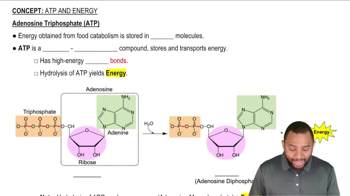
ATP hydrolysis is the process of breaking down adenosine triphosphate (ATP) into adenosine diphosphate (ADP) and inorganic phosphate, releasing energy. This energy is crucial for driving endergonic reactions, such as the activation of fatty acids, making it a key player in metabolic pathways.
Video consigliato:
Percorso guidato
2:20
Adenosine Triphosphate (ATP) Concept 2

Metabolic Strategies

In metabolism, one major strategy is the coupling of exergonic and endergonic reactions. By using the energy released from ATP hydrolysis, cells can drive unfavorable reactions forward, such as the synthesis of fatty acyl-CoA, thereby facilitating essential biochemical processes.
Video consigliato:
Percorso guidato
0:52
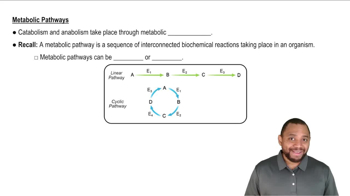
Metabolic Pathways Concept 2
Pratica correlata
Domanda del libro di testo

Each of these reactions is involved in one of the four stages of metabolism shown in Figure 21.4. Identify the stage in which each reaction occurs.

<IMAGE>

b. Oxidation of NADH coupled with synthesis of ATP

1205
views

Domanda del libro di testo

The reaction that follows is catalyzed by isocitrate dehydrogenase and occurs in two steps, the first of which (step A) is formation of an unstable intermediates (shown in brackets).

a. In which step is a coenzyme needed? Identify the coenzyme.

834
views
Domanda del libro di testo

Since no molecular oxygen participates in the citric acid cycle, the steps in which acetyl groups are oxidized to CO2 involve removal of hydride ions and hydrogen ions. What is the acceptor of hydride ions? What is the acceptor of hydrogen ions?

661
views
Domanda del libro di testo

The reaction that follows is catalyzed by isocitrate dehydrogenase and occurs in two steps, the first of which (step A) is formation of an unstable intermediates (shown in brackets).

b. In which step is CO2 evolved and a hydrogen ion added?

912
views
Domanda del libro di testo

Each of these reactions is involved in one of the four stages of metabolism shown in Figure 21.4. Identify the stage in which each reaction occurs.

<IMAGE>

c. Conversion of glucose to acetyl-CoA

1279
views
Domanda del libro di testo

Each of these reactions is involved in one of the four stages of metabolism shown in Figure 21.4. Identify the stage in which each reaction occurs.

<IMAGE>

a. Hydrolysis of starch to produce glucose

1104
views