Ch.21 The Generation of Biochemical Energy
McMurry - Fundamentals of General, Organic, and Biological Chemistry 8th Edition
McMurry8th EditionFundamentals of General, Organic, and Biological ChemistryISBN: 9780134015187Non è quello che usi tu?Cambia libro di testo
Capitolo 21, Problema 55b

Look at the eight steps of the citric acid cycle (Figure 21.8) and answer the following questions:
b. Which steps involve decarboxylation (loss of CO2)?

Guida verificata passo dopo passo
1
Step 1: Review the eight steps of the citric acid cycle (also known as the Krebs cycle or TCA cycle) to identify where decarboxylation occurs. Decarboxylation refers to the removal of a carbon atom from a molecule in the form of carbon dioxide (CO₂).
Step 2: Focus on the steps where a carbon atom is removed from the intermediate compounds of the cycle. This typically occurs when a six-carbon or five-carbon compound is converted into a smaller compound.
Step 3: Identify the enzymes involved in decarboxylation. In the citric acid cycle, decarboxylation is catalyzed by enzymes such as isocitrate dehydrogenase and α-ketoglutarate dehydrogenase.
Step 4: Note the specific reactions: (1) The conversion of isocitrate to α-ketoglutarate involves the loss of one CO₂ molecule, and (2) the conversion of α-ketoglutarate to succinyl-CoA involves the loss of another CO₂ molecule.
Step 5: Summarize that decarboxylation occurs in two steps of the citric acid cycle: the isocitrate to α-ketoglutarate step and the α-ketoglutarate to succinyl-CoA step, both of which release CO₂ as a byproduct.

Risposta video verificata per un problema simile:

Questa soluzione video è stata consigliata dai nostri tutor come utile per risolvere questo problema.
Durata del video:
4m

Concetti chiave

Ecco i concetti essenziali che devi comprendere per rispondere correttamente alla domanda.

Citric Acid Cycle

The citric acid cycle, also known as the Krebs cycle, is a series of enzymatic reactions that occur in the mitochondria, playing a crucial role in cellular respiration. It processes acetyl-CoA to produce energy carriers like NADH and FADH₂, which are essential for ATP production. Understanding this cycle is vital for identifying specific reactions, such as decarboxylation, that contribute to the overall metabolic pathway.
Video consigliato:
Percorso guidato
2:31
Citric Acid Cycle Summary Concept 12

Decarboxylation

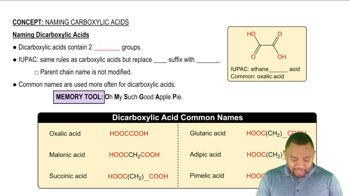
Decarboxylation is a biochemical reaction that involves the removal of a carboxyl group (-COOH) from a molecule, releasing carbon dioxide (CO₂) as a byproduct. In the context of the citric acid cycle, certain steps involve decarboxylation, which is significant for the cycle's progression and energy yield. Recognizing these steps helps in understanding how carbon atoms are lost during metabolism.
Video consigliato:
Percorso guidato
2:21
Naming Dicarboxylic Acids Concept 3

Enzymatic Reactions

Enzymatic reactions are biochemical processes facilitated by enzymes, which are proteins that speed up chemical reactions without being consumed in the process. In the citric acid cycle, specific enzymes catalyze each step, including those that involve decarboxylation. Understanding the role of these enzymes is essential for grasping how the cycle operates and how energy is efficiently extracted from substrates.
Video consigliato:
Percorso guidato
3:09
Triacylglycerol Reactions: Hydrolysis Concept 1