Ch.21 The Generation of Biochemical Energy
McMurry - Fundamentals of General, Organic, and Biological Chemistry 8th Edition
McMurry8th EditionFundamentals of General, Organic, and Biological ChemistryISBN: 9780134015187Non è quello che usi tu?Cambia libro di testo
Capitolo 21, Problema 68

What would happen to the citric acid cycle if NADH and FADH2 were not reoxidized?

Guida verificata passo dopo passo
1
Understand the role of NADH and FADH₂ in the citric acid cycle: These molecules are electron carriers that are reduced during the cycle. They transport electrons to the electron transport chain (ETC) where they are reoxidized to NAD⁺ and FAD, allowing the cycle to continue.
Recognize the importance of reoxidation: The reoxidation of NADH to NAD⁺ and FADH₂ to FAD is essential because the citric acid cycle requires NAD⁺ and FAD as reactants for key steps, such as the oxidation of isocitrate and succinate.
Consider the consequences of no reoxidation: If NADH and FADH₂ are not reoxidized, the levels of NAD⁺ and FAD would decrease, eventually halting the citric acid cycle because these cofactors would no longer be available to accept electrons during the cycle's reactions.
Understand the broader impact: Without the citric acid cycle functioning, the cell would be unable to produce sufficient ATP through oxidative phosphorylation, leading to a significant energy deficit.
Conclude the chain reaction: The lack of ATP production would impair cellular processes, potentially leading to cell death if alternative pathways (e.g., fermentation) cannot compensate for the energy shortfall.

Risposta video verificata per un problema simile:

Questa soluzione video è stata consigliata dai nostri tutor come utile per risolvere questo problema.
Durata del video:
2m

Concetti chiave

Ecco i concetti essenziali che devi comprendere per rispondere correttamente alla domanda.

Citric Acid Cycle

The citric acid cycle, also known as the Krebs cycle, is a series of enzymatic reactions that occur in the mitochondria, where acetyl-CoA is oxidized to produce energy. This cycle generates high-energy electron carriers, NADH and FADH₂, which are crucial for the subsequent production of ATP through oxidative phosphorylation.
Video consigliato:
Percorso guidato
2:31
Citric Acid Cycle Summary Concept 12

NADH and FADH₂

NADH and FADH₂ are electron carriers produced during the citric acid cycle and other metabolic pathways. They play a vital role in cellular respiration by donating electrons to the electron transport chain, which ultimately leads to the synthesis of ATP. Their reoxidation is essential for maintaining the flow of the cycle and energy production.
Video consigliato:
Percorso guidato
1:43
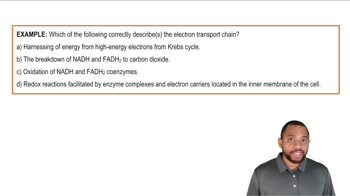
Intro to Electron Transport Chain Example 1

Reoxidation Process

Reoxidation refers to the process by which NADH and FADH₂ are converted back to their oxidized forms, NAD⁺ and FAD, respectively. This process is critical for the continuation of the citric acid cycle and is primarily achieved through the electron transport chain. If reoxidation does not occur, the cycle would halt, leading to a depletion of NAD⁺ and FAD, ultimately disrupting ATP production.
Video consigliato:
Percorso guidato
2:25
Processing of Pre-mRNA Concept 1