
Ch.21 The Generation of Biochemical Energy
McMurry - Fundamentals of General, Organic, and Biological Chemistry 8th Edition
McMurry8th EditionFundamentals of General, Organic, and Biological ChemistryISBN: 9780134015187Non è quello che usi tu?Cambia libro di testo
Capitolo 21, Problema 9

Which of the following is found in the coenzyme FAD?
a. Two heterocyclic rings
b. ADP
c. A substituted benzene ring
d. A phosphate anhydride bond

Guida verificata passo dopo passo
1
Understand the structure of FAD (Flavin Adenine Dinucleotide), which is a coenzyme involved in redox reactions. It consists of two main components: a flavin mononucleotide (FMN) and an adenosine monophosphate (AMP) group.
Analyze the components of FAD. The FMN portion contains a heterocyclic isoalloxazine ring system, while the AMP portion includes an adenine base, a ribose sugar, and a phosphate group.
Recognize that FAD contains two heterocyclic rings: the isoalloxazine ring in FMN and the adenine ring in AMP.
Note that FAD also contains ADP (adenosine diphosphate), which is formed by the combination of AMP and an additional phosphate group.
Review the other options: FAD does not contain a substituted benzene ring or a phosphate anhydride bond. Instead, it contains a phosphate ester bond connecting FMN and AMP.

Risposta video verificata per un problema simile:

Questa soluzione video è stata consigliata dai nostri tutor come utile per risolvere questo problema.
Durata del video:
1m

Concetti chiave

Ecco i concetti essenziali che devi comprendere per rispondere correttamente alla domanda.

Coenzymes

Coenzymes are organic molecules that assist enzymes in catalyzing biochemical reactions. They often serve as carriers for chemical groups or electrons during metabolic processes. FAD (flavin adenine dinucleotide) is a well-known coenzyme involved in redox reactions, particularly in the electron transport chain and the citric acid cycle.
Video consigliato:
Percorso guidato
1:02
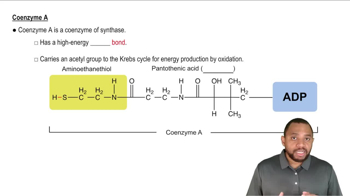
Coenzyme A Concept 4

Structure of FAD

FAD consists of a riboflavin (vitamin B2) moiety and an adenine nucleotide. The riboflavin part contains two heterocyclic rings, which are crucial for its function in electron transfer. Understanding the structural components of FAD is essential for recognizing how it interacts with enzymes and participates in metabolic pathways.
Video consigliato:
Percorso guidato
1:01
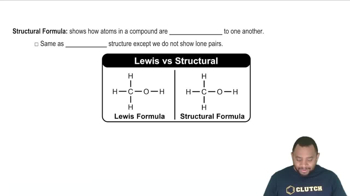
Structural Formula Concept 2

Heterocyclic Rings

Heterocyclic rings are cyclic compounds that contain atoms of at least two different elements as members of the ring. In the context of FAD, the presence of two heterocyclic rings contributes to its ability to accept and donate electrons, making it vital for various biochemical reactions. This structural feature is key to understanding the functionality of coenzymes like FAD.
Video consigliato:
Percorso guidato
2:10
Mutarotation Concept 1
Pratica correlata
Domanda del libro di testo

The hydrolysis of acetyl phosphate to give acetate and hydrogen phosphate ion has ∆G = -10.3 kcal/mol (-43.1 kJ/mol). Combine the equations and ∆G values to determine whether coupling of this reaction with phosphorylation of ADP to produce ATP is favorable. (You need give only compound names or abbreviations in the equations.)

908
views
Domanda del libro di testo

Why, do you suppose, the coenzyme for the reaction in the citric acid cycle that is catalyzed by succinate dehydrogenase is FAD and not NAD+?

1151
views
Domanda del libro di testo

Look ahead to Figure 21.8 for the citric acid cycle.

<IMAGE>

b. What class of enzymes carry out these reactions?

815
views
Domanda del libro di testo

Look ahead to Figure 21.8 for the citric acid cycle.

<IMAGE>

a. Draw the structures of the reactants in steps 3, 6, and 8, and indicate which hydrogen atoms are removed in these reactions.

701
views
Domanda del libro di testo

A common metabolic strategy is the lack of reactivity—that is, the slowness to react—of compounds whose breakdown is exergonic. For example, hydrolysis of ATP to ADP or adenosine monophosphate (AMP) is exergonic but does not take place without an appropriate enzyme present. Why would the cell use this metabolic strategy?

935
views
Domanda del libro di testo

One of the steps in lipid metabolism is the reaction of glycerol (1,2,3-propanetriol, HOCH2CH(OH)CH2OH, with ATP to yield glycerol 1-phosphate. Write the equation for this reaction using the curved arrow symbolism.

1260
views