Ch.21 The Generation of Biochemical Energy
McMurry - Fundamentals of General, Organic, and Biological Chemistry 8th Edition
McMurry8th EditionFundamentals of General, Organic, and Biological ChemistryISBN: 9780134015187Non è quello che usi tu?Cambia libro di testo
Capitolo 21, Problema 13

Why, do you suppose, the coenzyme for the reaction in the citric acid cycle that is catalyzed by succinate dehydrogenase is FAD and not NAD+?

Guida verificata passo dopo passo
1
Understand the role of coenzymes in redox reactions: Coenzymes like FAD and NAD⁺ are electron carriers that participate in oxidation-reduction reactions. They differ in their redox potentials, which determine their ability to accept or donate electrons.
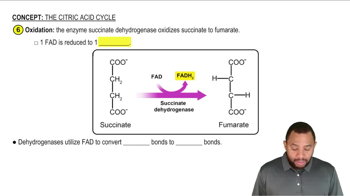
Recognize the specific reaction catalyzed by succinate dehydrogenase: This enzyme catalyzes the oxidation of succinate to fumarate in the citric acid cycle. During this reaction, two hydrogen atoms (with their electrons) are removed from succinate.
Consider the energy requirements of the reaction: The oxidation of succinate to fumarate involves the formation of a double bond. This reaction does not release enough energy to reduce NAD⁺ to NADH, as NAD⁺ requires a higher energy input for reduction.
Understand why FAD is used: FAD has a lower redox potential compared to NAD⁺, meaning it can accept electrons in reactions with lower energy changes. This makes FAD the appropriate coenzyme for the succinate dehydrogenase reaction.
Conclude the reasoning: The choice of FAD over NAD⁺ is due to the energy constraints of the reaction. FAD is better suited to accept the electrons from the oxidation of succinate because the energy released in this reaction is sufficient to reduce FAD to FADH₂ but not NAD⁺ to NADH.

Risposta video verificata per un problema simile:

Questa soluzione video è stata consigliata dai nostri tutor come utile per risolvere questo problema.
Durata del video:
4m

Concetti chiave

Ecco i concetti essenziali che devi comprendere per rispondere correttamente alla domanda.

Citric Acid Cycle

The citric acid cycle, also known as the Krebs cycle, is a series of enzymatic reactions that occur in the mitochondria, where acetyl-CoA is oxidized to produce energy. It plays a crucial role in cellular respiration, generating ATP, NADH, and FADH₂, which are essential for the electron transport chain. Understanding this cycle is vital for grasping how energy is produced in aerobic organisms.
Video consigliato:
Percorso guidato
2:31
Citric Acid Cycle Summary Concept 12

Succinate Dehydrogenase

Succinate dehydrogenase is an enzyme that catalyzes the oxidation of succinate to fumarate in the citric acid cycle. It is unique because it is the only enzyme that participates in both the citric acid cycle and the electron transport chain, directly linking these two metabolic pathways. This enzyme uses FAD as a coenzyme, which is crucial for its function in facilitating the transfer of electrons.
Video consigliato:
Percorso guidato
0:58
Phase C - Oxaloacetate Regeneration Concept 9

FAD vs. NAD⁺

FAD (flavin adenine dinucleotide) and NAD⁺ (nicotinamide adenine dinucleotide) are both important coenzymes involved in redox reactions. FAD is typically used in reactions that involve the formation of double bonds, such as the oxidation of succinate, while NAD⁺ is more commonly involved in reactions that produce alcohols or aldehydes. The choice of coenzyme can influence the reaction pathway and the type of products formed.
Video consigliato:
Percorso guidato
3:33
Enantiomers vs Diastereomers Concept 1