Ch.1 Chemistry in Our Lives
Timberlake - Chemistry: An Introduction to General, Organic, and Biological Chemistry 13th Edition
Timberlake13th EditionChemistry: An Introduction to General, Organic, and Biological ChemistryISBN: 9780134421353Non è quello che usi tu?Cambia libro di testo
Capitolo 1, Problema 28a

Which number in each of the following pairs is smaller?
a. 4.9 × 10⁻³ or 5.5 × 10⁻⁹

Guida verificata passo dopo passo
1
Step 1: Understand the problem. You are comparing two numbers written in scientific notation: 4.9 × 10⁻³ and 5.5 × 10⁻⁹. The goal is to determine which number is smaller.
Step 2: Recall how scientific notation works. A number in scientific notation is expressed as \( a \times 10^n \), where \( a \) is the coefficient (a number between 1 and 10) and \( n \) is the exponent (which indicates the power of 10).
Step 3: Compare the exponents first. The exponent \( n \) determines the order of magnitude of the number. A smaller exponent (more negative) indicates a smaller number. In this case, \( 10^{-3} \) is larger than \( 10^{-9} \), so the number with \( 10^{-9} \) will be smaller.
Step 4: If the exponents were the same, you would compare the coefficients (\( a \)). However, since the exponents are different here, you do not need to compare the coefficients because the exponent already determines which number is smaller.
Step 5: Conclude that the number with the smaller exponent, 5.5 × 10⁻⁹, is the smaller number in this pair.

Risposta video verificata per un problema simile:

Questa soluzione video è stata consigliata dai nostri tutor come utile per risolvere questo problema.
Durata del video:
1m

Concetti chiave

Ecco i concetti essenziali che devi comprendere per rispondere correttamente alla domanda.

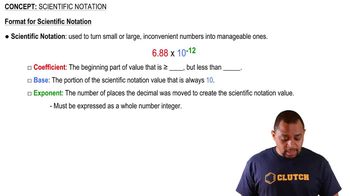
Scientific Notation

Scientific notation is a way of expressing numbers that are too large or too small to be conveniently written in decimal form. It is typically formatted as 'a x 10^n', where 'a' is a number greater than or equal to 1 and less than 10, and 'n' is an integer. This notation simplifies calculations and comparisons of very large or very small numbers.
Video consigliato:
Percorso guidato
01:41
Scientific Notation

Comparing Exponents

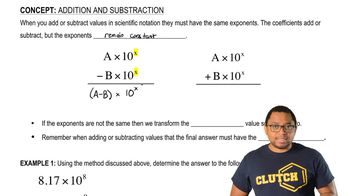
When comparing numbers in scientific notation, the first step is to compare the exponents of 10. The number with the larger exponent is the larger number. If the exponents are the same, then the coefficients (the 'a' values) are compared to determine which number is smaller or larger.
Video consigliato:
Percorso guidato
01:55
Addition and Subtraction Operations

Decimal Conversion

To compare numbers in scientific notation directly, converting them to decimal form can be helpful. For example, 4.9 x 10⁻³ equals 0.0049, and 5.5 x 10⁻⁹ equals 0.0000000055. This conversion allows for straightforward comparison of the two values by examining their decimal representations.
Video consigliato:
Percorso guidato
03:45
Conversion Factors (Simplified) Example 2