Ch.11 Introduction to Organic Chemistry: Hydrocarbons
Timberlake - Chemistry: An Introduction to General, Organic, and Biological Chemistry 13th Edition
Timberlake13th EditionChemistry: An Introduction to General, Organic, and Biological ChemistryISBN: 9780134421353Non è quello che usi tu?Cambia libro di testo
Capitolo 11, Problema 1c

Identify each of the following as a formula of an organic or inorganic compound. For an organic compound, indicate if represented as molecular formula, expanded, or condensed structural formula:
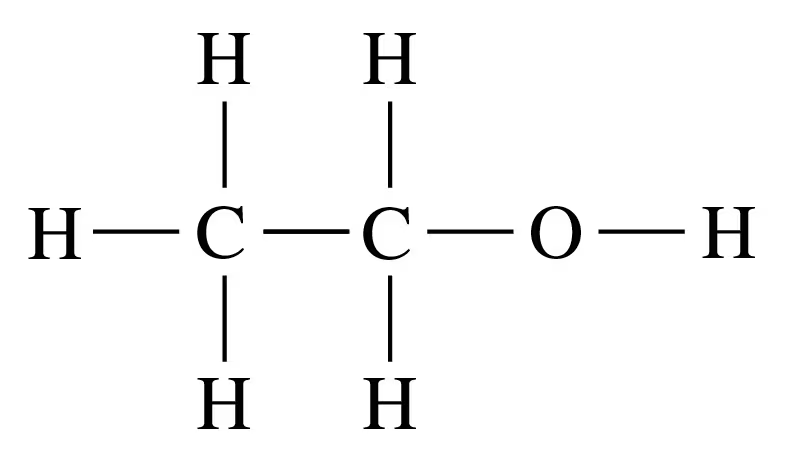
c. Structural formula of an organic compound showing carbon, hydrogen, and oxygen atoms.

Guida verificata passo dopo passo
1
Step 1: Understand the distinction between organic and inorganic compounds. Organic compounds primarily contain carbon atoms bonded to hydrogen, oxygen, nitrogen, or other elements, while inorganic compounds generally do not have carbon-hydrogen bonds.
Step 2: Examine the provided image (not visible here) to identify the type of compound. Look for the presence of carbon atoms and their bonding patterns to determine if it is organic or inorganic.
Step 3: If the compound is organic, classify its representation. A molecular formula shows the number and type of atoms (e.g., C2H6O), an expanded structural formula shows all bonds between atoms, and a condensed structural formula simplifies the representation by grouping atoms (e.g., CH3CH2OH).
Step 4: Analyze the structure in the image to determine if it matches one of these representations. For example, if it shows all bonds explicitly, it is an expanded structural formula. If it groups atoms, it is a condensed structural formula.
Step 5: Based on your analysis, classify the compound as organic or inorganic and specify the type of formula if it is organic.

Risposta video verificata per un problema simile:

Questa soluzione video è stata consigliata dai nostri tutor come utile per risolvere questo problema.

Concetti chiave

Ecco i concetti essenziali che devi comprendere per rispondere correttamente alla domanda.

Organic Compounds

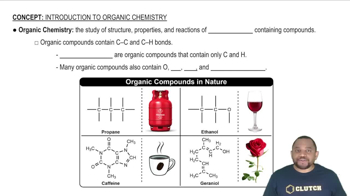
Organic compounds are primarily composed of carbon atoms, often in combination with hydrogen, oxygen, nitrogen, and other elements. They are characterized by their covalent bonding and can form complex structures, including chains and rings. Common examples include hydrocarbons, alcohols, and acids, which are essential in biological processes and industrial applications.
Video consigliato:
Percorso guidato
2:26
Introduction to Organic Chemistry Concept 1

Inorganic Compounds

Inorganic compounds typically do not contain carbon-hydrogen (C-H) bonds and include a wide range of substances such as minerals, metals, and salts. They can be ionic or covalent and often have simpler structures compared to organic compounds. Examples include water (H2O), sodium chloride (NaCl), and sulfuric acid (H2SO4), which play crucial roles in various chemical reactions and processes.
Video consigliato:
Percorso guidato
02:11
Naming Ionic Compounds

Structural Formulas

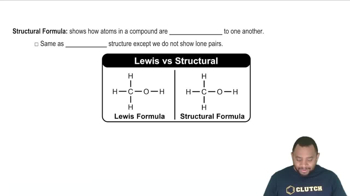
Structural formulas represent the arrangement of atoms within a molecule, illustrating how atoms are bonded together. They can be depicted in different forms: molecular formulas show the number of each type of atom, expanded structural formulas provide detailed bonding information, and condensed structural formulas offer a simplified view. Understanding these representations is essential for analyzing the properties and reactivity of compounds.
Video consigliato:
Percorso guidato
1:01
Structural Formula Concept 2