

Ch.18 Metabolic Pathways and ATP Production
Timberlake - Chemistry: An Introduction to General, Organic, and Biological Chemistry 13th Edition
Timberlake13th EditionChemistry: An Introduction to General, Organic, and Biological ChemistryISBN: 9780134421353Non è quello che usi tu?Cambia libro di testo
Capitolo 18, Problema 95d

Match the following ATP yields to reactions a to g:
1.5 ATP 2.5 ATP 7 ATP 10 ATP
12 ATP 32 ATP 36 ATP
d. Acetyl CoA goes through one turn of the citric acid cycle.

Guida verificata passo dopo passo
1
Step 1: Understand the context of the problem. The question is asking to match ATP yields to specific reactions. In this case, the reaction mentioned is 'Acetyl CoA goes through one turn of the citric acid cycle.'
Step 2: Recall the key concept: During one turn of the citric acid cycle, Acetyl CoA is oxidized, producing NADH, FADH2, and GTP/ATP. These molecules are then used in oxidative phosphorylation to generate ATP.
Step 3: Break down the ATP yield from one turn of the citric acid cycle. Typically, one turn produces 3 NADH, 1 FADH2, and 1 GTP. Each NADH contributes approximately 2.5 ATP, each FADH2 contributes approximately 1.5 ATP, and GTP is equivalent to 1 ATP.
Step 4: Calculate the total ATP yield from one turn of the citric acid cycle using the contributions: (3 NADH × 2.5 ATP) + (1 FADH2 × 1.5 ATP) + (1 GTP × 1 ATP). This gives the total ATP yield for the reaction.
Step 5: Match the calculated ATP yield to the options provided in the problem. The correct ATP yield for one turn of the citric acid cycle corresponds to one of the values listed (e.g., 10 ATP).

Risposta video verificata per un problema simile:

Questa soluzione video è stata consigliata dai nostri tutor come utile per risolvere questo problema.
Durata del video:
4m

Concetti chiave

Ecco i concetti essenziali che devi comprendere per rispondere correttamente alla domanda.

ATP Yield in Cellular Respiration

ATP yield refers to the amount of adenosine triphosphate (ATP) produced during metabolic processes, particularly in cellular respiration. Different pathways, such as glycolysis, the citric acid cycle, and oxidative phosphorylation, contribute varying amounts of ATP. Understanding these yields is crucial for matching specific reactions to their corresponding ATP outputs.
Video consigliato:

Citric Acid Cycle (Krebs Cycle)

The citric acid cycle, also known as the Krebs cycle, is a key metabolic pathway that occurs in the mitochondria. It processes acetyl CoA to produce energy-rich molecules, including NADH and FADH2, which are later used in the electron transport chain to generate ATP. One complete turn of the cycle typically yields 10 ATP, making it essential for understanding ATP production from acetyl CoA.
Video consigliato:
Percorso guidato
2:31
Citric Acid Cycle Summary Concept 12

Oxidative Phosphorylation

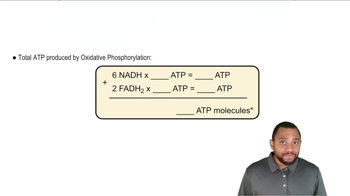
Oxidative phosphorylation is the final stage of cellular respiration, occurring in the inner mitochondrial membrane. It involves the electron transport chain and chemiosmosis, where electrons from NADH and FADH2 are transferred through protein complexes, ultimately leading to the production of ATP. This process is responsible for the majority of ATP generated during respiration, with yields often reaching up to 32 or 36 ATP per glucose molecule.
Video consigliato:
Percorso guidato
0:51
Oxidative Phosphorylation Concept 2