Ch.11 Introduction to Organic Chemistry: Hydrocarbons
Timberlake - Chemistry: An Introduction to General, Organic, and Biological Chemistry 14th Edition
Timberlake14th EditionChemistry: An Introduction to General, Organic, and Biological ChemistryISBN: 9781292472249Non è quello che usi tu?Cambia libro di testo
Capitolo 11, Problema 2d

Identify each of the following as a formula of an organic or inorganic compound. For an organic compound, indicate if represented as molecular formula, expanded, or condensed structural formula:
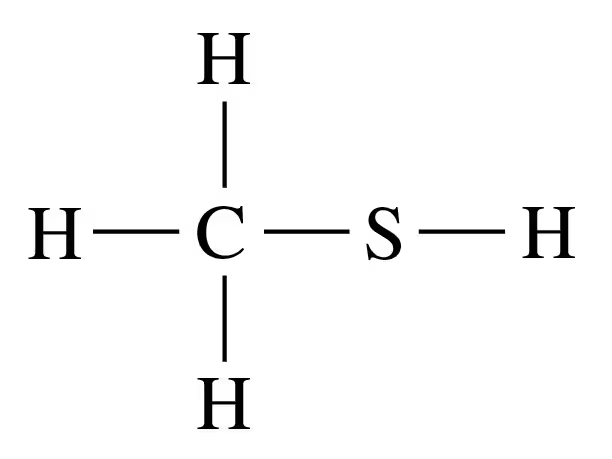
d. Structural formula of a carbon atom bonded to four hydrogen atoms and one sulfur atom.

Guida verificata passo dopo passo
1
Step 1: Analyze the structural formula provided in the image. The formula shows a central carbon atom (C) bonded to four hydrogen atoms (H) and one sulfur atom (S). This arrangement indicates the presence of covalent bonds between these atoms.
Step 2: Determine if the compound is organic or inorganic. Organic compounds are primarily composed of carbon atoms bonded to hydrogen, oxygen, nitrogen, or other nonmetals. Since this structure contains carbon bonded to hydrogen and sulfur, it is classified as an organic compound.
Step 3: Identify the type of formula represented. The image shows the arrangement of atoms and bonds explicitly, which is characteristic of an expanded structural formula. Expanded structural formulas display all atoms and bonds in the molecule.
Step 4: Consider the functional group present. The sulfur atom bonded to the carbon suggests the presence of a thiol group (-SH), which is a common functional group in organic chemistry.
Step 5: Summarize the classification. The compound is an organic compound represented as an expanded structural formula, and it contains a thiol functional group.

Concetti chiave

Ecco i concetti essenziali che devi comprendere per rispondere correttamente alla domanda.

Organic Compounds

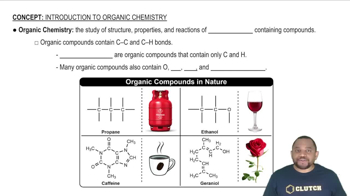
Organic compounds are primarily composed of carbon atoms bonded to hydrogen, oxygen, nitrogen, and other elements. They are characterized by the presence of carbon-hydrogen (C-H) bonds. The structure shown in the image represents an organic compound due to the carbon atom's bonding with hydrogen and sulfur, indicating its organic nature.
Video consigliato:
Percorso guidato
2:26
Introduction to Organic Chemistry Concept 1

Structural Formulas

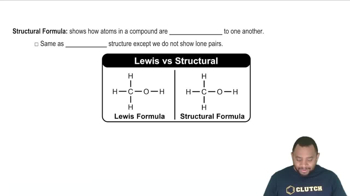
Structural formulas depict the arrangement of atoms within a molecule, showing how atoms are connected. The image illustrates a condensed structural formula, where the carbon atom is central, bonded to four hydrogen atoms and one sulfur atom. This representation helps visualize the molecular structure and connectivity of the compound.
Video consigliato:
Percorso guidato
1:01
Structural Formula Concept 2

Molecular vs. Expanded Formulas

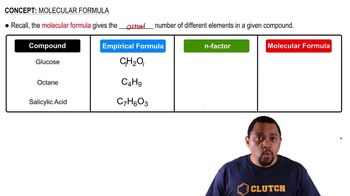
Molecular formulas provide the number of each type of atom in a compound, while expanded formulas show all bonds explicitly. The image does not provide a molecular formula but rather a condensed structural formula, which is a simplified version of an expanded formula, indicating the connectivity without showing all individual bonds.
Video consigliato:
Percorso guidato
02:08
Molecular Formula