Ch.13 Carbohydrates
Timberlake - Chemistry: An Introduction to General, Organic, and Biological Chemistry 14th Edition
Timberlake14th EditionChemistry: An Introduction to General, Organic, and Biological ChemistryISBN: 9781292472249Non è quello che usi tu?Cambia libro di testo
Capitolo 13, Problema 28

D-Fructose is the sweetest monosaccharide. How does the Fischer projection of D-fructose differ from that of D-glucose?

Guida verificata passo dopo passo
1
Understand the Fischer projection: A Fischer projection is a two-dimensional representation of a molecule's three-dimensional structure, commonly used for carbohydrates. The vertical lines represent bonds going away from the viewer, and the horizontal lines represent bonds coming toward the viewer.
Recall the structure of D-glucose: D-glucose is an aldohexose, meaning it has six carbon atoms and an aldehyde group (-CHO) at the top of its Fischer projection. The remaining carbons are part of a chain with hydroxyl (-OH) groups attached in a specific configuration.
Recall the structure of D-fructose: D-fructose is a ketohexose, meaning it has six carbon atoms but a ketone group (C=O) at the second carbon instead of an aldehyde group. This is the key structural difference between D-fructose and D-glucose.
Compare the functional groups: In the Fischer projection of D-glucose, the aldehyde group is at the top (C1), while in D-fructose, the ketone group is at the second carbon (C2). This difference in the functional group location is the primary distinction between the two monosaccharides.
Analyze the hydroxyl group arrangement: While the functional group differs, the arrangement of hydroxyl (-OH) groups on the remaining carbons (C3 to C5) in D-fructose is similar to that of D-glucose. However, the presence of the ketone group in D-fructose shifts the numbering of the carbons compared to D-glucose.

Risposta video verificata per un problema simile:

Questa soluzione video è stata consigliata dai nostri tutor come utile per risolvere questo problema.
Durata del video:
3m

Concetti chiave

Ecco i concetti essenziali che devi comprendere per rispondere correttamente alla domanda.

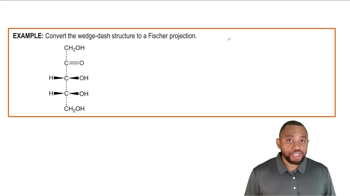
Fischer Projection

The Fischer projection is a two-dimensional representation of a three-dimensional organic molecule, particularly useful for depicting the stereochemistry of carbohydrates. In this format, the carbon chain is arranged vertically, with the most oxidized carbon at the top. The horizontal lines represent bonds that project out of the plane towards the viewer, while vertical lines represent bonds that extend behind the plane.
Video consigliato:
Percorso guidato
0:48
Fischer Projections Example 1

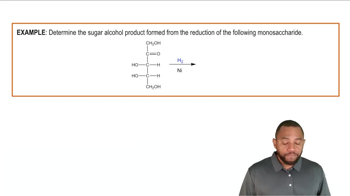
Monosaccharides

Monosaccharides are the simplest form of carbohydrates, consisting of single sugar units that cannot be hydrolyzed into simpler sugars. They serve as the building blocks for more complex carbohydrates. D-Fructose and D-Glucose are both hexoses, meaning they contain six carbon atoms, but they differ in structure and sweetness due to their distinct functional groups and arrangement of atoms.
Video consigliato:
Percorso guidato
0:55
Reduction of Monosaccharides Example 1

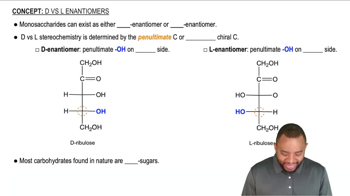
Stereochemistry

Stereochemistry refers to the study of the spatial arrangement of atoms in molecules and how this affects their chemical behavior. In carbohydrates, stereochemistry is crucial because the orientation of hydroxyl groups around the carbon skeleton determines the molecule's properties and reactivity. D-Fructose and D-Glucose have different stereochemical configurations, which is evident in their Fischer projections.
Video consigliato:
Percorso guidato
1:30
D vs L Enantiomers Concept 1