Ch.14 Carboxylic Acids, Esters, Amines, and Amides
Timberlake - Chemistry: An Introduction to General, Organic, and Biological Chemistry 14th Edition
Timberlake14th EditionChemistry: An Introduction to General, Organic, and Biological ChemistryISBN: 9781292472249Non è quello che usi tu?Cambia libro di testo
Capitolo 14, Problema 81a

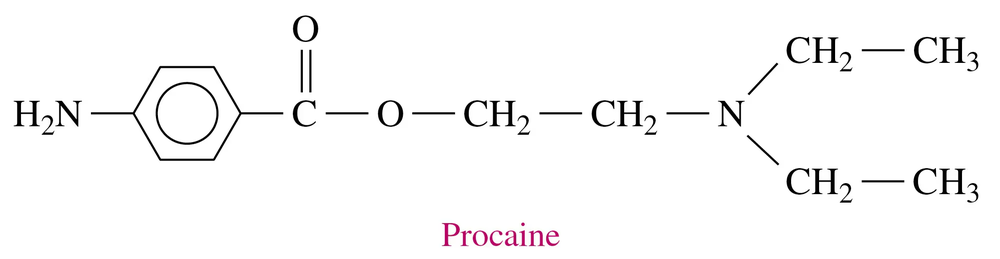
Novocain, a local anesthetic, is the ammonium salt of procaine.
Condensed structural formula of procaine, a local anesthetic, showing its chemical structure.
a. Draw the condensed structural formula for the ammonium salt (procaine hydrochloride) formed when procaine reacts with HCl. (Hint: The tertiary amine reacts with HCl.)

Guida verificata passo dopo passo
1
Identify the functional group in procaine that reacts with HCl. In this case, the tertiary amine group (-NR3) is the reactive site because it can accept a proton (H+) to form an ammonium ion.
Understand the reaction mechanism: When a tertiary amine reacts with HCl, the lone pair of electrons on the nitrogen atom accepts a proton (H+) from HCl, forming an ammonium ion (-NR3H+). The chloride ion (Cl-) remains as a counterion.
Modify the condensed structural formula of procaine to reflect the reaction. Add a hydrogen atom to the nitrogen atom of the tertiary amine group, converting it into an ammonium ion (-NR3H+).
Include the chloride ion (Cl-) as part of the product to represent the salt formed. This is written as the ammonium ion paired with Cl- (e.g., -NR3H+ Cl-).
Write the final condensed structural formula for procaine hydrochloride, ensuring that the ammonium ion and chloride ion are clearly shown. The rest of the molecule remains unchanged from the original procaine structure.

Risposta video verificata per un problema simile:

Questa soluzione video è stata consigliata dai nostri tutor come utile per risolvere questo problema.
Durata del video:
4m

Concetti chiave

Ecco i concetti essenziali che devi comprendere per rispondere correttamente alla domanda.

Ammonium Salts

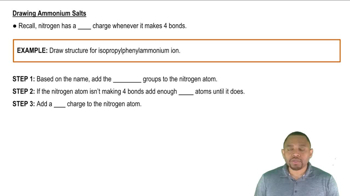
Ammonium salts are formed when an amine reacts with an acid, resulting in a positively charged ammonium ion. In the case of procaine, a tertiary amine, it reacts with hydrochloric acid (HCl) to form procaine hydrochloride, an ammonium salt. This process involves the protonation of the nitrogen atom in the amine, leading to the formation of a stable ionic compound.
Video consigliato:
Percorso guidato
1:04
Drawing Ammonium Salts Concept 2

Condensed Structural Formula

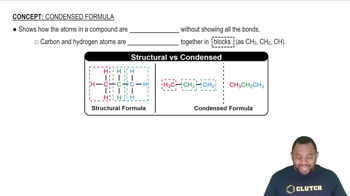
A condensed structural formula provides a simplified representation of a molecule, showing the arrangement of atoms without depicting all the bonds explicitly. It typically lists the atoms in a sequence that reflects their connectivity, allowing chemists to visualize the structure quickly. For procaine hydrochloride, the condensed formula will illustrate the ammonium ion and the accompanying chloride ion.
Video consigliato:
Percorso guidato
1:53
Condensed Formula Concept 1

Tertiary Amines

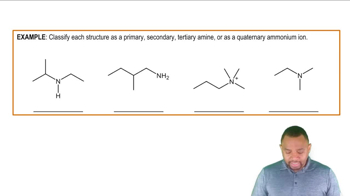
Tertiary amines are nitrogen-containing compounds where the nitrogen atom is bonded to three carbon atoms and lacks hydrogen atoms directly attached to it. This structure influences their reactivity, particularly in acid-base reactions. In the context of procaine, its tertiary amine nature allows it to readily react with HCl to form the corresponding ammonium salt.
Video consigliato:
Percorso guidato
0:54
Amine Classification Example 1