Ch.14 Carboxylic Acids, Esters, Amines, and Amides
Timberlake - Chemistry: An Introduction to General, Organic, and Biological Chemistry 14th Edition
Timberlake14th EditionChemistry: An Introduction to General, Organic, and Biological ChemistryISBN: 9781292472249Non è quello che usi tu?Cambia libro di testo
Capitolo 14, Problema 79b

Propyl acetate is the ester that gives the odor and smell of pears.
b. Use condensed structural formulas to write the balanced chemical equation for the formation of propyl acetate.

Guida verificata passo dopo passo
1
Identify the reactants involved in the formation of propyl acetate. Esters are typically formed through a reaction between a carboxylic acid and an alcohol. In this case, the carboxylic acid is acetic acid (CH₃COOH), and the alcohol is propanol (CH₃CH₂CH₂OH).
Write the condensed structural formulas for the reactants: acetic acid (CH₃COOH) and propanol (CH₃CH₂CH₂OH).
Determine the products of the reaction. The esterification reaction produces an ester (propyl acetate, CH₃COOCH₂CH₂CH₃) and water (H₂O).
Write the balanced chemical equation for the reaction using condensed structural formulas: CH₃COOH + CH₃CH₂CH₂OH → CH₃COOCH₂CH₂CH₃ + H₂O.
Verify that the equation is balanced by ensuring the number of atoms of each element is the same on both sides of the equation.

Risposta video verificata per un problema simile:

Questa soluzione video è stata consigliata dai nostri tutor come utile per risolvere questo problema.
Durata del video:
2m

Concetti chiave

Ecco i concetti essenziali che devi comprendere per rispondere correttamente alla domanda.

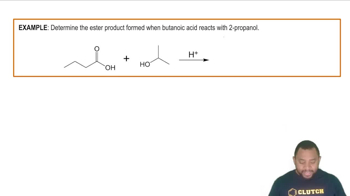
Esterification

Esterification is a chemical reaction that forms an ester from an alcohol and a carboxylic acid. In this process, the hydroxyl group (-OH) from the acid and a hydrogen atom from the alcohol combine to release water (H2O), resulting in the formation of the ester. This reaction is typically catalyzed by an acid and is reversible, meaning that the ester can be hydrolyzed back into the original alcohol and acid.
Video consigliato:
Percorso guidato
0:46
Ester Reactions: Esterification Example 1

Condensed Structural Formula

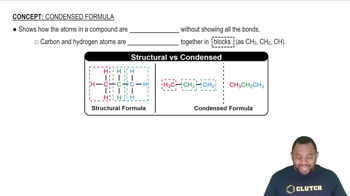
A condensed structural formula is a way of representing a chemical compound that shows the arrangement of atoms in a molecule without depicting all the bonds explicitly. It provides a simplified view of the molecular structure, indicating how atoms are connected. For example, propyl acetate can be represented as CH3CH2COOCH2CH3, which highlights the functional groups and the carbon chain in a compact format.
Video consigliato:
Percorso guidato
1:53
Condensed Formula Concept 1

Balanced Chemical Equation

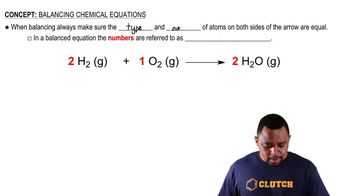
A balanced chemical equation represents a chemical reaction with equal numbers of each type of atom on both sides of the equation. This ensures the law of conservation of mass is upheld, meaning that matter is neither created nor destroyed in a chemical reaction. Balancing involves adjusting coefficients in front of the chemical formulas to achieve this equality, which is essential for accurately depicting the stoichiometry of the reaction.
Video consigliato:
Percorso guidato
01:32
Balancing Chemical Equations (Simplified) Concept 1