Ch.18 Metabolic Pathways and ATP Production
Timberlake - Chemistry: An Introduction to General, Organic, and Biological Chemistry 14th Edition
Timberlake14th EditionChemistry: An Introduction to General, Organic, and Biological ChemistryISBN: 9781292472249Non è quello che usi tu?Cambia libro di testo
Capitolo 18, Problema 41d

Refer to the diagram of the citric acid cycle in Figure 18.13 to answer each of the following:
d. What are the decarboxylation reactions?

Guida verificata passo dopo passo
1
Identify the decarboxylation reactions in the citric acid cycle. Decarboxylation refers to the removal of a carbon dioxide (CO₂) molecule from a compound during a chemical reaction.
Locate the steps in the citric acid cycle where CO₂ is released. These reactions typically involve the conversion of a molecule into another with one less carbon atom.
Examine the enzymes involved in these reactions. In the citric acid cycle, decarboxylation reactions are catalyzed by enzymes such as isocitrate dehydrogenase and α-ketoglutarate dehydrogenase.
Understand the chemical transformations. For example, isocitrate is converted to α-ketoglutarate, releasing CO₂, and α-ketoglutarate is converted to succinyl-CoA, releasing another CO₂.
Review the overall significance of these reactions. Decarboxylation reactions are crucial for energy production as they contribute to the generation of NADH, which is used in the electron transport chain to produce ATP.

Risposta video verificata per un problema simile:

Questa soluzione video è stata consigliata dai nostri tutor come utile per risolvere questo problema.
Durata del video:
1m

Concetti chiave

Ecco i concetti essenziali che devi comprendere per rispondere correttamente alla domanda.

Decarboxylation

Decarboxylation is a chemical reaction that involves the removal of a carboxyl group (-COOH) from a molecule, releasing carbon dioxide (CO2). In the context of the citric acid cycle, this process is crucial for the conversion of certain intermediates, allowing the cycle to continue and produce energy. It typically occurs in specific steps where enzymes facilitate the reaction, ensuring that the cycle efficiently generates ATP and other high-energy molecules.
Video consigliato:
Percorso guidato
2:21
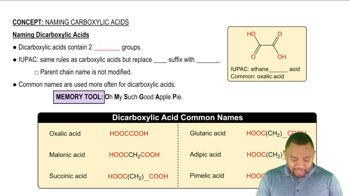
Naming Dicarboxylic Acids Concept 3

Citric Acid Cycle

The citric acid cycle, also known as the Krebs cycle, is a series of enzymatic reactions that take place in the mitochondria of cells. It plays a central role in cellular respiration by oxidizing acetyl-CoA to produce energy carriers such as NADH and FADH2, as well as ATP. Understanding the cycle's steps, including where decarboxylation occurs, is essential for grasping how cells convert nutrients into usable energy.
Video consigliato:
Percorso guidato
2:31
Citric Acid Cycle Summary Concept 12

Enzymatic Regulation

Enzymatic regulation refers to the control of enzyme activity within metabolic pathways, including the citric acid cycle. Specific enzymes catalyze decarboxylation reactions, and their activity can be influenced by factors such as substrate availability, product concentration, and allosteric regulators. This regulation ensures that the cycle operates efficiently and responds to the energy needs of the cell, making it a key concept for understanding metabolic control.
Video consigliato:
Percorso guidato
2:57
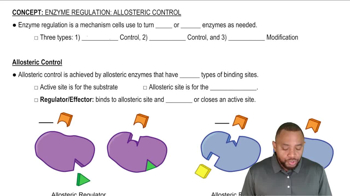
Allosteric Control Concept 1