Ch.2 Chemistry and Measurements
Timberlake - Chemistry: An Introduction to General, Organic, and Biological Chemistry 14th Edition
Timberlake14th EditionChemistry: An Introduction to General, Organic, and Biological ChemistryISBN: 9781292472249Non è quello che usi tu?Cambia libro di testo
Capitolo 2, Problema 119

How many milliliters of gasoline have a mass of 1.2 kg?

Guida verificata passo dopo passo
1
Identify the given values: the mass of gasoline is 1.2 kg. From Table 2.8, find the density of gasoline (typically around 0.74 g/mL, but confirm the exact value from the table).
Convert the mass of gasoline from kilograms to grams, since the density is given in g/mL. Use the conversion factor: 1 kg = 1000 g. The formula is: \( \text{mass in grams} = \text{mass in kilograms} \times 1000 \).
Use the formula for density: \( \text{Density} = \frac{\text{Mass}}{\text{Volume}} \). Rearrange the formula to solve for volume: \( \text{Volume} = \frac{\text{Mass}}{\text{Density}} \).
Substitute the mass (in grams) and the density (from Table 2.8) into the rearranged formula to calculate the volume in milliliters.
Ensure the final volume is expressed in milliliters (mL) and check that the units cancel appropriately during the calculation.

Risposta video verificata per un problema simile:

Questa soluzione video è stata consigliata dai nostri tutor come utile per risolvere questo problema.
Durata del video:
1m

Concetti chiave

Ecco i concetti essenziali che devi comprendere per rispondere correttamente alla domanda.

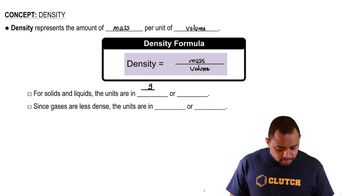
Density

Density is defined as mass per unit volume and is a crucial property of substances. In the context of gasoline, density allows us to relate the mass of gasoline to its volume. For example, if gasoline has a density of approximately 0.74 kg/L, this means that 1 liter of gasoline weighs 0.74 kg. Understanding density is essential for converting between mass and volume.
Video consigliato:

Volume Calculation

Volume calculation involves determining the space occupied by a substance, which can be derived from its mass and density. To find the volume of gasoline that corresponds to a mass of 1.2 kg, one can use the formula: Volume = Mass / Density. This calculation is fundamental in various scientific and engineering applications, particularly in fluid dynamics and material science.
Video consigliato:
Percorso guidato
03:13
Calculate Oxidation Numbers

Unit Conversion

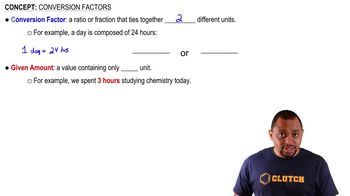
Unit conversion is the process of converting a quantity expressed in one set of units to another. In this question, converting kilograms to milliliters requires an understanding of the relationship between mass and volume, as well as the appropriate conversion factors. For instance, knowing that 1 liter equals 1000 milliliters is essential for expressing the final answer in the desired units.
Video consigliato:
Percorso guidato
01:56
Conversion Factors (Simplified) Concept 1