
Ch.2 Chemistry and Measurements
Timberlake - Chemistry: An Introduction to General, Organic, and Biological Chemistry 14th Edition
Timberlake14th EditionChemistry: An Introduction to General, Organic, and Biological ChemistryISBN: 9781292472249Non è quello che usi tu?Cambia libro di testo
Capitolo 2, Problema 72b

What is the density (g/mL) of each of the following samples?
b. A 14.3 - cm3 sample of tin has a mass of 0.104 kg.

Guida verificata passo dopo passo
1
Step 1: Recall the formula for density: \( \text{Density} = \frac{\text{Mass}}{\text{Volume}} \). This formula relates the mass and volume of a substance to its density.
Step 2: Convert the mass from kilograms (kg) to grams (g). Since \( 1 \, \text{kg} = 1000 \, \text{g} \), multiply the given mass (0.104 kg) by 1000 to express it in grams.
Step 3: Ensure the volume is in cubic centimeters (cm³), which is already provided as 14.3 cm³. No conversion is needed for the volume in this case.
Step 4: Substitute the values for mass (in grams) and volume (in cm³) into the density formula: \( \text{Density} = \frac{\text{Mass (g)}}{\text{Volume (cm³)}} \).
Step 5: Perform the division to calculate the density in \( \text{g/cm³} \), which is equivalent to \( \text{g/mL} \) since \( 1 \, \text{cm³} = 1 \, \text{mL} \).

Risposta video verificata per un problema simile:

Questa soluzione video è stata consigliata dai nostri tutor come utile per risolvere questo problema.
Durata del video:
1m

Concetti chiave

Ecco i concetti essenziali che devi comprendere per rispondere correttamente alla domanda.

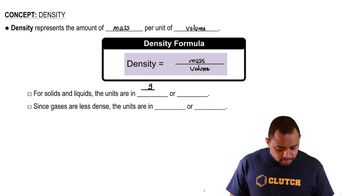
Density

Density is defined as the mass of a substance divided by its volume, typically expressed in grams per milliliter (g/mL) or kilograms per cubic meter (kg/m³). It is a fundamental property that helps identify materials and understand their behavior in different contexts. The formula for density is D = m/V, where D is density, m is mass, and V is volume.
Video consigliato:

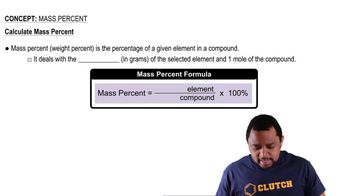
Mass and Volume

Mass is a measure of the amount of matter in an object, usually measured in grams (g) or kilograms (kg). Volume, on the other hand, is the amount of space that a substance occupies, measured in cubic centimeters (cm³) or milliliters (mL). Understanding the relationship between mass and volume is crucial for calculating density and interpreting the properties of materials.
Video consigliato:
Percorso guidato
00:38
Mass Percent Concept

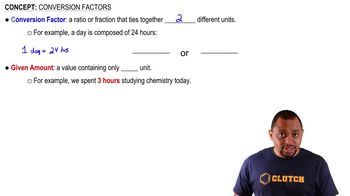
Unit Conversion

Unit conversion is the process of converting a quantity expressed in one set of units to another. In the context of the question, converting the mass of tin from kilograms to grams is necessary since density is typically expressed in g/mL. This involves multiplying the mass in kg by 1000 to obtain the mass in grams, ensuring consistency in units for accurate density calculation.
Video consigliato:
Percorso guidato
01:56
Conversion Factors (Simplified) Concept 1