Ch.3 Matter and Energy
Timberlake - Chemistry: An Introduction to General, Organic, and Biological Chemistry 14th Edition
Timberlake14th EditionChemistry: An Introduction to General, Organic, and Biological ChemistryISBN: 9781292472249Non è quello che usi tu?Cambia libro di testo
Capitolo 3, Problema 105b

A metal is thought to be titanium or aluminum. When 4.7 g of the metal absorbs 11 J, its temperature rises by 4.5 °C.
b. Would you identify the metal as titanium or aluminum (see TABLE 3.11)?

Guida verificata passo dopo passo
1
Step 1: Recall the formula for heat transfer: \( q = m \cdot c \cdot \Delta T \), where \( q \) is the heat absorbed, \( m \) is the mass of the substance, \( c \) is the specific heat capacity, and \( \Delta T \) is the change in temperature.
Step 2: Rearrange the formula to solve for \( c \), the specific heat capacity: \( c = \frac{q}{m \cdot \Delta T} \).
Step 3: Substitute the given values into the formula: \( q = 11 \, \text{J} \), \( m = 4.7 \, \text{g} \), and \( \Delta T = 4.5 \, \degree \text{C} \).
Step 4: Calculate \( c \) using the substituted values. This will give the specific heat capacity of the metal in \( \text{J/g} \cdot \degree \text{C} \).
Step 5: Compare the calculated specific heat capacity to the values provided in Table 3.11 for titanium and aluminum (not shown in the image). Identify the metal based on the closest match.

Risposta video verificata per un problema simile:

Questa soluzione video è stata consigliata dai nostri tutor come utile per risolvere questo problema.
Durata del video:
2m

Concetti chiave

Ecco i concetti essenziali che devi comprendere per rispondere correttamente alla domanda.

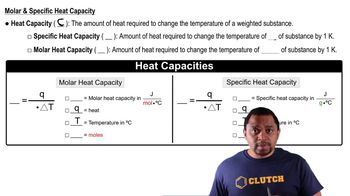
Specific Heat Capacity

Specific heat capacity is the amount of heat required to raise the temperature of one gram of a substance by one degree Celsius. It is a crucial property for identifying materials, as different metals have distinct specific heat capacities. In this problem, knowing the specific heat capacity of titanium and aluminum will help determine which metal is present based on the heat absorbed and the temperature change.
Video consigliato:

Heat Transfer

Heat transfer refers to the movement of thermal energy from one object or substance to another. In this context, the metal absorbs heat, which causes its temperature to rise. The relationship between the heat absorbed, the mass of the metal, and the change in temperature is described by the formula Q = mcΔT, where Q is the heat absorbed, m is the mass, c is the specific heat capacity, and ΔT is the change in temperature.
Video consigliato:

Identifying Metals

Identifying metals based on their physical properties, such as specific heat capacity, is a common practice in materials science. By comparing the calculated specific heat capacity of the unknown metal with known values for titanium and aluminum, one can determine which metal is present. This process often involves using tables or charts that list the specific heat capacities of various metals for quick reference.
Video consigliato:
Percorso guidato
01:08
Periodic Trend: Metallic Character