
Suppose a mixture contains helium and oxygen gases. If the partial pressure of helium is the same as the partial pressure of oxygen, what do you know about the number of helium atoms compared to the number of oxygen molecules? Explain.
Ch.8 Gases
Timberlake14th EditionChemistry: An Introduction to General, Organic, and Biological ChemistryISBN: 9781292472249Non è quello che usi tu?Cambia libro di testo
Capitolo 8, Problema 44a
A sample of argon gas has a volume of 735 mL at a pressure of 1.20 atm and a temperature of 112 °C. What is the final volume of the gas, in milliliters, when the pressure and temperature of the gas sample are changed to the following, if the amount of gas does not change?
a. 658 mmHg and 281 K
Guida verificata passo dopo passo1
Step 1: Identify the given values and convert them to appropriate units if necessary. The initial volume (V₁) is 735 mL, the initial pressure (P₁) is 1.20 atm, and the initial temperature (T₁) is 112 °C. Convert T₁ to Kelvin using the formula T(K) = T(°C) + 273.15. The final pressure (P₂) is 658 mmHg, and the final temperature (T₂) is 281 K. Convert P₂ to atm using the conversion factor 1 atm = 760 mmHg.
Step 2: Write down the combined gas law equation: . Rearrange the equation to solve for the final volume (V₂): .
Step 3: Substitute the known values into the equation. Use the converted values for T₁ (in Kelvin) and P₂ (in atm). Ensure all units are consistent: pressure in atm, volume in mL, and temperature in Kelvin.
Step 4: Perform the calculations step by step. First, calculate the numerator: multiply P₁, V₁, and T₂. Then calculate the denominator: multiply P₂ and T₁. Finally, divide the numerator by the denominator to find V₂.
Step 5: Verify the units of the final answer. The volume should be in milliliters (mL). Double-check the calculations to ensure accuracy and confirm that the result makes sense based on the given conditions.

Risposta video verificata per un problema simile:
Questa soluzione video è stata consigliata dai nostri tutor come utile per risolvere questo problema.
Durata del video:
2mConcetti chiave
Ecco i concetti essenziali che devi comprendere per rispondere correttamente alla domanda.
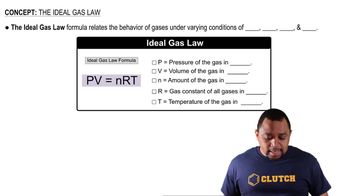
Ideal Gas Law
The Ideal Gas Law is a fundamental equation in chemistry that relates the pressure, volume, temperature, and number of moles of a gas. It is expressed as PV = nRT, where P is pressure, V is volume, n is the number of moles, R is the ideal gas constant, and T is temperature in Kelvin. This law allows us to predict how a gas will behave under different conditions.
Video consigliato:
Percorso guidato
The Ideal Gas Law Concept 1
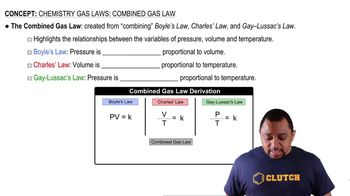
Gas Laws
Gas laws describe the relationships between pressure, volume, and temperature of gases. Key laws include Boyle's Law (pressure and volume), Charles's Law (volume and temperature), and Gay-Lussac's Law (pressure and temperature). Understanding these laws is essential for solving problems involving changes in gas conditions, as they provide the necessary relationships to calculate unknown variables.
Video consigliato:
Percorso guidato
Chemistry Gas Laws: Combined Gas Law
Unit Conversion
Unit conversion is the process of converting a quantity expressed in one set of units to another. In this problem, it is crucial to convert pressure from atm to mmHg and temperature from Celsius to Kelvin to ensure consistency in calculations. Mastery of unit conversion is vital for accurately applying gas laws and obtaining correct results.
Video consigliato:
Percorso guidato
Conversion Factors (Simplified) Concept 1
Pratica correlata
Domanda del libro di testo
904
views
Domanda del libro di testo
In certain lung ailments such as emphysema, there is a decrease in the ability of oxygen to diffuse into the blood.
a. How would the partial pressure of oxygen in the blood change?
886
views
Domanda del libro di testo
Rearrange the variables in the combined gas law to solve for P2.
2088
views
Domanda del libro di testo
A solution containing 80. g of NaNO3 in 75 g of H2O at 50 °C is cooled to 20 °C. b. How many grams of solid NaNO3 crystallized after cooling?
29
views
Domanda del libro di testo
Use the molar volume to calculate each of the following at STP:
a. the number of moles of CO2 in 4.00 L of CO2 gas
2556
views
Domanda del libro di testo
A gas sample has a volume of 0.256 L with an unknown temperature. The same gas has a volume of 0.198 L when the temperature is 32 °C, with no change in the pressure or amount of gas. What was the initial temperature, in degrees Celsius, of the gas?
1059
views
