
Ch.8 Gases
Timberlake - Chemistry: An Introduction to General, Organic, and Biological Chemistry 14th Edition
Timberlake14th EditionChemistry: An Introduction to General, Organic, and Biological ChemistryISBN: 9781292472249Non è quello che usi tu?Cambia libro di testo
Capitolo 8, Problema 80

What is the total pressure, in millimeters of mercury, of a gas mixture containing argon gas at 0.25 atm, helium gas at 350 mmHg, and nitrogen gas at 360 Torr?

Guida verificata passo dopo passo
1
Step 1: Understand the problem. The goal is to calculate the total pressure of a gas mixture. According to Dalton's Law of Partial Pressures, the total pressure of a gas mixture is the sum of the partial pressures of each gas in the mixture.
Step 2: Convert all pressure units to the same unit. Since the problem asks for the total pressure in millimeters of mercury (mmHg), convert the pressure of argon gas from atm to mmHg using the conversion factor: 1 atm = 760 mmHg. Use the formula: \( P_{\text{argon}} = 0.25 \text{ atm} \times 760 \text{ mmHg/atm} \).
Step 3: Note that the pressure of helium gas is already given in mmHg (350 mmHg), so no conversion is needed for this value.
Step 4: Recognize that the pressure of nitrogen gas is given in Torr. Since 1 Torr is equivalent to 1 mmHg, the pressure of nitrogen gas is already in the correct unit (360 mmHg).
Step 5: Add the partial pressures of all three gases together to find the total pressure: \( P_{\text{total}} = P_{\text{argon}} + P_{\text{helium}} + P_{\text{nitrogen}} \). Substitute the values in mmHg to calculate the total pressure.

Risposta video verificata per un problema simile:

Questa soluzione video è stata consigliata dai nostri tutor come utile per risolvere questo problema.
Durata del video:
2m

Concetti chiave

Ecco i concetti essenziali che devi comprendere per rispondere correttamente alla domanda.

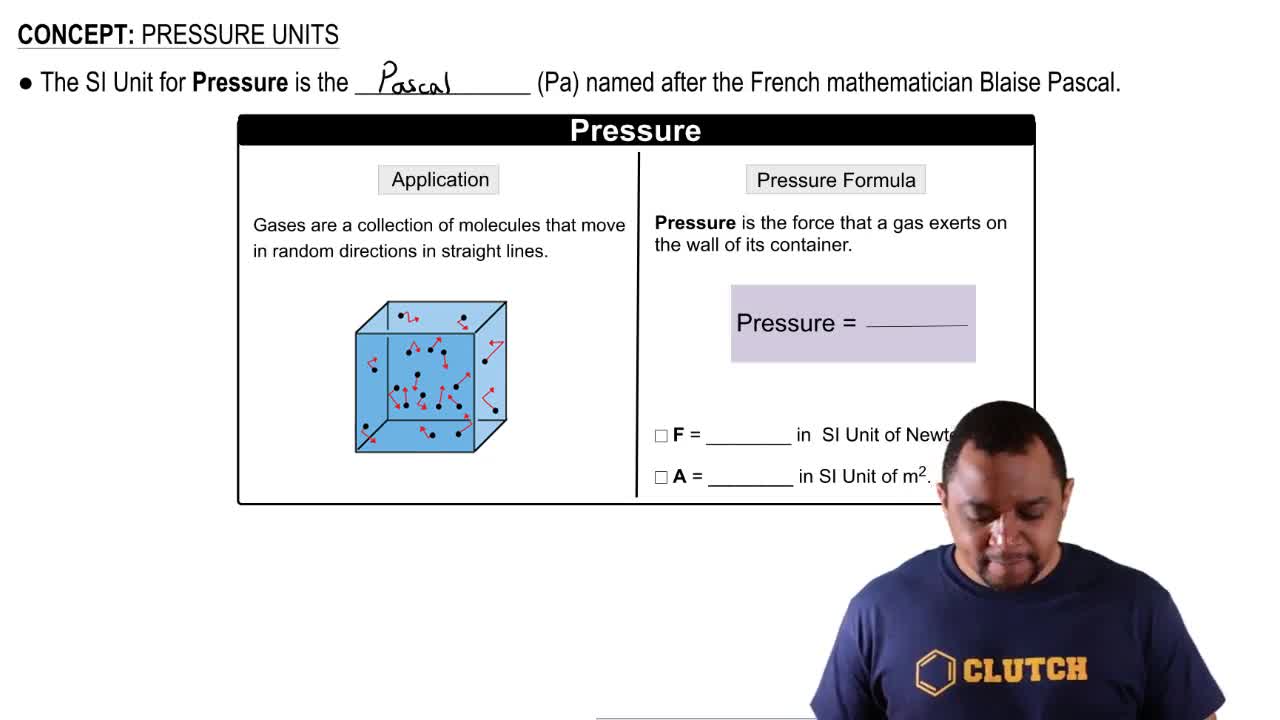
Gas Pressure Units

Gas pressure can be measured in various units, including atmospheres (atm), millimeters of mercury (mmHg), and torr. Understanding these units is crucial for converting pressures to a common unit for calculations. Notably, 1 atm is equivalent to 760 mmHg and 760 torr, allowing for straightforward conversions between these measurements.
Video consigliato:
Percorso guidato
01:15
Pressure Units Concept 1

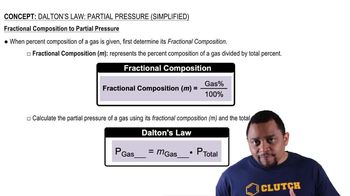
Dalton's Law of Partial Pressures

Dalton's Law states that in a mixture of non-reacting gases, the total pressure exerted is equal to the sum of the partial pressures of each individual gas. This principle is essential for calculating the total pressure of a gas mixture, as it allows us to add the pressures of the individual gases together to find the overall pressure.
Video consigliato:
Percorso guidato
01:02
Dalton's Law: Partial Pressure (Simplified) Concept 3

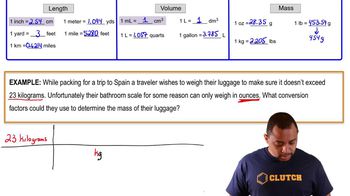
Pressure Conversion

To accurately calculate the total pressure of a gas mixture, it is often necessary to convert all pressures to the same unit. For instance, converting atm to mmHg or torr ensures consistency in the calculations. This step is vital for applying Dalton's Law effectively and obtaining the correct total pressure of the gas mixture.
Video consigliato:
Percorso guidato
03:45
Conversion Factors (Simplified) Example 2