Skip to main content
Intermediate Algebra
Il mio corso
Impara
Preparazione agli esami
AI Tutor
Guide di studio
Flashcard
Esplora
Prova l'app
Il mio corso
Impara
Preparazione agli esami
AI Tutor
Guide di studio
Flashcard
Esplora
Prova l'app
Indietro
Factorials quiz
Puoi toccare per girare la carta.
What mathematical operation does the exclamation point represent when placed after a number or variable?
Puoi toccare per girare la carta.
👆
What mathematical operation does the exclamation point represent when placed after a number or variable?
It represents the factorial operation, which multiplies all whole numbers from the given number down to 1.
Avanzamenti del tracciato
I pulsanti di controllo sono stati cambiati in modalità "navigazione".
1/15
Flashcard correlate
Pratica correlata
Video consigliati
Factorials definitions
Factorials
15 Termini
Factorials
13. Sequences, Series, and the Binomial Theorem
5 Problemi
Argomento
ZacharyFrye
Geometric Sequences
13. Sequences, Series, and the Binomial Theorem
5 Problemi
Argomento
ZacharyFrye
13. Sequences, Series, and the Binomial Theorem
4 Argomenti
12 Problemi
Capitolo
AllySteele
VideoThumbView.guidedCourse
5:22
Factorials
78
views
VideoThumbView.guidedCourse
02:04
Factorials Example 2
28
views
VideoThumbView.guidedCourse
01:40
Factorials Example 1
65
views
Termini in questo insieme (15)
Nascondere definizioni
What mathematical operation does the exclamation point represent when placed after a number or variable?
It represents the factorial operation, which multiplies all whole numbers from the given number down to 1.
How do you calculate 4 factorial (4!)?
Multiply 4 × 3 × 2 × 1, which equals 24.
What is the value of 1 factorial (1!)?
1 factorial is equal to 1.
How is 2 factorial (2!) calculated?
2 factorial is 2 × 1, which equals 2.
What is the value of 3 factorial (3!)?
3 factorial is 3 × 2 × 1, which equals 6.
How do you calculate 5 factorial (5!)?
Multiply 5 × 4 × 3 × 2 × 1, which equals 120.
What pattern can you observe in calculating consecutive factorials?
Each factorial is the previous factorial multiplied by the new number.
How can you express n factorial (n!) in terms of the previous factorial?
n factorial is n × (n-1) factorial.
What is the value of 6 factorial (6!)?
6 factorial is 6 × 5 × 4 × 3 × 2 × 1, which equals 720.
How can you simplify 4 × 3 factorial?
4 × 3 factorial is the same as 4 factorial, which equals 24.
How do you simplify 100 factorial divided by 99 factorial (100! / 99!)?
100! / 99! simplifies to 100, since 100! = 100 × 99! and 99! cancels out.
What is the value of 0 factorial (0!)?
0 factorial is defined as 1.
Why is 0 factorial (0!) equal to 1?
By the factorial formula, 1! = 1 × 0!, and since 1! = 1, 0! must be 1.
In which areas of mathematics are factorials commonly used?
Factorials are used in combinatorics, probability, sequences, and polynomial operations.
How does understanding factorials help in simplifying algebraic expressions?
It allows you to break down and cancel terms, making calculations easier and more efficient.
 IndietroIndietro

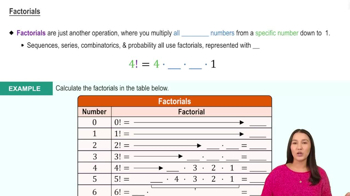
 5:22
5:22