Skip to main content
Intermediate Algebra
Il mio corso
Impara
Preparazione agli esami
AI Tutor
Guide di studio
Flashcard
Esplora
Prova l'app
Il mio corso
Impara
Preparazione agli esami
AI Tutor
Guide di studio
Flashcard
Esplora
Prova l'app
Indietro
Introduction to Sequences definitions
Puoi toccare per girare la carta.
Sequence
Puoi toccare per girare la carta.
👆
Sequence
A function mapping positive integers to numbers, forming a list that can model patterns and predict values.
Avanzamenti del tracciato
I pulsanti di controllo sono stati cambiati in modalità "navigazione".
1/15
Flashcard correlate
Pratica correlata
Video consigliati
Introduction to Sequences quiz
Introduction to Sequences
15 Termini
Introduction to Sequences
13. Sequences, Series, and the Binomial Theorem
5 Problemi
Argomento
ErnestBlazevic
Arithmetic Sequences
13. Sequences, Series, and the Binomial Theorem
5 Problemi
Argomento
ZacharyFrye
13. Sequences, Series, and the Binomial Theorem
4 Argomenti
12 Problemi
Capitolo
AllySteele
VideoThumbView.guidedCourse
4:19
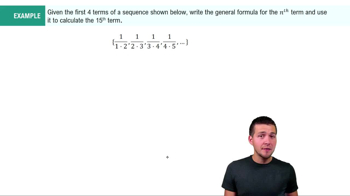
Writing a General Formula Example 6
57
views
VideoThumbView.guidedCourse
5:52
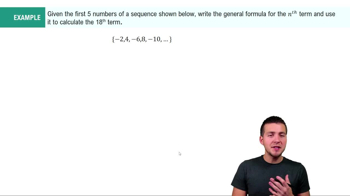
Writing a General Formula Example 5
72
views
VideoThumbView.guidedCourse
01:26
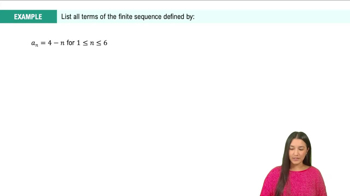
Intro to Sequences Example 2
72
views
Termini in questo insieme (15)
Nascondere definizioni
Sequence
A function mapping positive integers to numbers, forming a list that can model patterns and predict values.
Domain
The set of positive integers used as input values for generating terms in a sequence.
Index
A positive integer representing the position of a term within a sequence, often denoted by n.
Term
An output value in a sequence, determined by substituting the index into the general formula.
General Term
An expression involving the index that defines how each term in a sequence is calculated.
Explicit Formula
An equation that directly relates the index to the value of each term in a sequence.
Finite Sequence
A list of terms with a limited number of values, ending at a specific index.
Infinite Sequence
A list of terms that continues indefinitely, with no upper bound on the index.
Arithmetic Progression
A sequence where each term increases or decreases by a constant difference from the previous term.
Geometric Progression
A sequence where each term is obtained by multiplying the previous term by a constant factor.
Exponent
A mathematical notation indicating repeated multiplication, often used in geometric sequences.
Numerical Coefficient
A constant multiplied by the index or other expressions in the general term of a sequence.
Alternating Sign
A pattern in a sequence where the sign of each term switches between positive and negative.
Fraction
A term in a sequence expressed as a ratio of two numbers, often involving patterns in numerator and denominator.
Pattern
A recognizable regularity in the arrangement of terms within a sequence, guiding formula creation.
 IndietroIndietro


 4:19
4:19