What is the difference between an acid and a base?
Guida verificata passo dopo passo
1
Identify the definitions of acids and bases according to the Arrhenius, Brønsted-Lowry, and Lewis theories.
According to the Arrhenius theory, an acid is a substance that increases the concentration of hydrogen ions (H⁺) in aqueous solution, while a base increases the concentration of hydroxide ions (OH⁻).
According to the Brønsted-Lowry theory, an acid is a proton (H⁺) donor, and a base is a proton acceptor.
According to the Lewis theory, an acid is an electron pair acceptor, and a base is an electron pair donor.
Consider examples of each type of acid and base to understand how they behave in chemical reactions, such as HCl as an acid and NaOH as a base in the Arrhenius context.
Risposta video verificata per un problema simile:
Questa soluzione video è stata consigliata dai nostri tutor come utile per risolvere questo problema.
Durata del video:
57s
Guarda un video:
0 Commenti
Concetti chiave
Ecco i concetti essenziali che devi comprendere per rispondere correttamente alla domanda.
Acids
Acids are substances that can donate protons (H⁺ ions) in a chemical reaction. They typically have a sour taste and can turn blue litmus paper red. Common examples include hydrochloric acid (HCl) and sulfuric acid (H₂SO₄). Acids are characterized by their ability to increase the concentration of hydrogen ions in a solution.
Bases are substances that can accept protons or donate hydroxide ions (OH⁻) in a chemical reaction. They usually have a bitter taste and can turn red litmus paper blue. Examples include sodium hydroxide (NaOH) and ammonia (NH₃). Bases increase the concentration of hydroxide ions in a solution, which can neutralize acids.
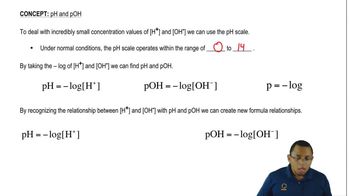
The pH scale is a measure of the acidity or basicity of a solution, ranging from 0 to 14. A pH less than 7 indicates an acidic solution, while a pH greater than 7 indicates a basic solution. A pH of 7 is considered neutral, as seen in pure water. The scale is logarithmic, meaning each whole number change represents a tenfold change in acidity or basicity.