Which of the following equations are balanced? Balance those that need it.
a. CaC₂+2 H₂O→Ca(OH)₂+C₂H₂
b. C₂H₈N₂+2 N₂O₄→2 N₂+2 CO₂+4 H₂O
c. 3 MgO +2 Fe→Fe₂O₃+3 Mg
d. N₂O→N₂+O₂
Guida verificata passo dopo passo
1
Identify the number of each type of atom on both sides of each equation.
For equation (a), count the atoms: Ca, C, H, and O on both sides. Check if they are equal.
For equation (b), count the atoms: C, H, N, and O on both sides. Check if they are equal.
For equation (c), count the atoms: Mg, O, and Fe on both sides. Check if they are equal.
For equation (d), count the atoms: N and O on both sides. Check if they are equal.
Risposta video verificata per un problema simile:
Questa soluzione video è stata consigliata dai nostri tutor come utile per risolvere questo problema.
Durata del video:
3m
Guarda un video:
0 Commenti
Concetti chiave
Ecco i concetti essenziali che devi comprendere per rispondere correttamente alla domanda.
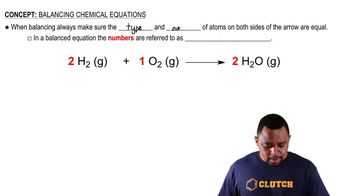
Balancing Chemical Equations
Balancing chemical equations involves ensuring that the number of atoms for each element is the same on both sides of the equation. This is based on the law of conservation of mass, which states that matter cannot be created or destroyed in a chemical reaction. To balance an equation, coefficients are adjusted in front of the chemical formulas, rather than changing the formulas themselves.
Balancing Chemical Equations (Simplified) Concept 1
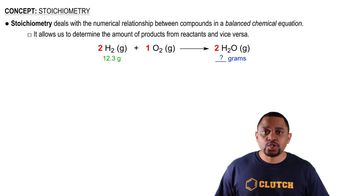
Stoichiometry
Stoichiometry is the quantitative relationship between the reactants and products in a chemical reaction. It allows chemists to predict the amounts of substances consumed and produced in a reaction based on balanced equations. Understanding stoichiometry is essential for calculating yields, determining limiting reactants, and performing conversions between moles, mass, and volume.
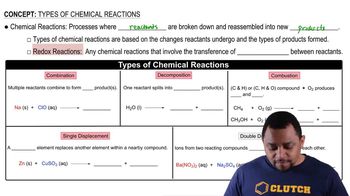
Chemical reactions can be classified into several types, including synthesis, decomposition, single replacement, and double replacement reactions. Each type has distinct characteristics and patterns that can help in predicting the products of a reaction. Recognizing the type of reaction can aid in balancing equations and understanding the underlying chemical processes.