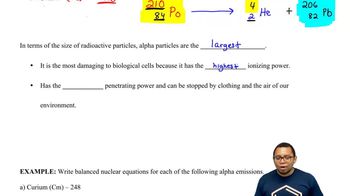
Ionizing radiation has enough energy to remove tightly bound electrons from atoms, creating ions.
When ionizing radiation passes through cells, it can ionize molecules within the cell, including DNA.
The ionization of DNA molecules can cause breaks in the DNA strands, leading to mutations.
These mutations can disrupt normal cell function, potentially leading to cell death or uncontrolled cell division (cancer).
Additionally, ionizing radiation can generate free radicals, which are highly reactive and can further damage cellular components.
Risposta video verificata per un problema simile:
Questa soluzione video è stata consigliata dai nostri tutor come utile per risolvere questo problema.
Durata del video:
1m
Guarda un video:
0 Commenti
Concetti chiave
Ecco i concetti essenziali che devi comprendere per rispondere correttamente alla domanda.
Ionizing Radiation
Ionizing radiation refers to high-energy particles or electromagnetic waves that have enough energy to remove tightly bound electrons from atoms, creating ions. This type of radiation includes alpha particles, beta particles, gamma rays, and X-rays. The energy from ionizing radiation can disrupt atomic structures, leading to chemical changes in biological tissues.
Cellular damage from ionizing radiation primarily occurs through direct and indirect mechanisms. Direct damage happens when radiation directly hits DNA or other critical cellular components, causing breaks in the DNA strands. Indirect damage occurs when radiation interacts with water molecules, producing free radicals that can subsequently damage DNA and other cellular structures.
Cells have evolved various DNA repair mechanisms to fix damage caused by ionizing radiation. These include base excision repair, nucleotide excision repair, and double-strand break repair pathways. While these mechanisms can effectively repair some damage, excessive radiation can overwhelm these systems, leading to mutations, cell death, or cancer.

 1:35 minuti
 Guida verificata passo dopo passo
 02:06
02:06