A gas has a volume of 2.84 L at 1.00 atm and 0 °C. At what temperature does it have a volume of 7.50 L at 520 mmHg?
Guida verificata passo dopo passo
1
Identify the initial and final conditions of the gas: initial volume (V1) = 2.84 L, initial pressure (P1) = 1.00 atm, initial temperature (T1) = 0 °C, final volume (V2) = 7.50 L, final pressure (P2) = 520 mmHg.
Convert all units to be consistent: convert the initial temperature from Celsius to Kelvin using T(K) = T(°C) + 273.15, and convert the final pressure from mmHg to atm using the conversion factor 1 atm = 760 mmHg.
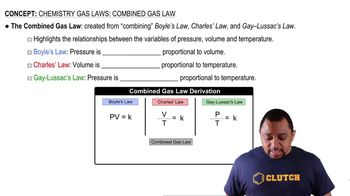
Use the combined gas law, which is \( \frac{P_1 \cdot V_1}{T_1} = \frac{P_2 \cdot V_2}{T_2} \), to relate the initial and final states of the gas.
Rearrange the combined gas law to solve for the final temperature \( T_2 \): \( T_2 = \frac{P_2 \cdot V_2 \cdot T_1}{P_1 \cdot V_1} \).
Substitute the known values into the equation and solve for \( T_2 \) in Kelvin.
Risposta video verificata per un problema simile:
Questa soluzione video è stata consigliata dai nostri tutor come utile per risolvere questo problema.
Durata del video:
2m
Guarda un video:
0 Commenti
Concetti chiave
Ecco i concetti essenziali che devi comprendere per rispondere correttamente alla domanda.
Ideal Gas Law
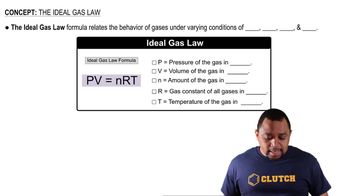
The Ideal Gas Law is a fundamental equation in chemistry that relates the pressure, volume, temperature, and number of moles of a gas. It is expressed as PV = nRT, where P is pressure, V is volume, n is the number of moles, R is the ideal gas constant, and T is temperature in Kelvin. This law allows us to predict the behavior of gases under different conditions.
Charles's Law states that the volume of a gas is directly proportional to its temperature when pressure is held constant. Mathematically, it can be expressed as V1/T1 = V2/T2. This concept is crucial for understanding how changes in temperature affect the volume of a gas, which is essential for solving the given problem.
In gas calculations, it is often necessary to convert pressure units to ensure consistency. In this case, the initial pressure is given in atmospheres (atm) and the final pressure in millimeters of mercury (mmHg). Knowing that 1 atm equals 760 mmHg allows for the conversion of pressure units, which is vital for applying gas laws correctly.