The diagram to the right shows plots of vapor pressure versus temperature for a solvent and a solution.
What is the approximate boiling-point elevation for the solution?
Guida verificata passo dopo passo
1
Identify the boiling point of the pure solvent from the vapor pressure versus temperature plot. This is the temperature at which the vapor pressure of the solvent equals the atmospheric pressure.
Identify the boiling point of the solution from the same plot. This is the temperature at which the vapor pressure of the solution equals the atmospheric pressure.
Calculate the boiling-point elevation by subtracting the boiling point of the pure solvent from the boiling point of the solution.
Recall that boiling-point elevation is a colligative property, which means it depends on the number of solute particles in the solution, not their identity.
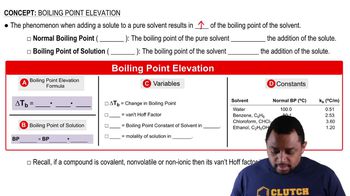
Use the formula for boiling-point elevation, \( \Delta T_b = i \cdot K_b \cdot m \), where \( \Delta T_b \) is the boiling-point elevation, \( i \) is the van't Hoff factor, \( K_b \) is the ebullioscopic constant, and \( m \) is the molality of the solution, to understand the factors affecting the elevation.
Risposta video verificata per un problema simile:
Questa soluzione video è stata consigliata dai nostri tutor come utile per risolvere questo problema.
Durata del video:
14m
Guarda un video:
0 Commenti
Concetti chiave
Ecco i concetti essenziali che devi comprendere per rispondere correttamente alla domanda.
Vapor Pressure
Vapor pressure is the pressure exerted by a vapor in equilibrium with its liquid or solid phase at a given temperature. It reflects the tendency of particles to escape from the liquid phase into the vapor phase. As temperature increases, vapor pressure also increases, which is crucial for understanding boiling points.
Boiling point elevation is a colligative property that describes the increase in the boiling point of a solvent when a solute is dissolved in it. This phenomenon occurs because the presence of solute particles disrupts the formation of vapor above the liquid, requiring a higher temperature to reach the vapor pressure equal to atmospheric pressure.
Colligative properties are properties of solutions that depend on the number of solute particles in a given amount of solvent, rather than the identity of the solute. These properties include boiling point elevation, freezing point depression, vapor pressure lowering, and osmotic pressure, and they are essential for understanding how solutes affect the physical properties of solvents.

 14:24 minuti
 Guida verificata passo dopo passo
 01:15
01:15