Consider the following bonds: Ca and O, C and O, K and O, Oand O, and N and O. (6.7)
d. Arrange the covalent bonds in order of decreasing polarity.
Guida verificata passo dopo passo
1
Identify the electronegativity values for each element involved in the bonds: Ca, C, K, O, and N.
Calculate the difference in electronegativity for each bond: Ca-O, C-O, K-O, O-O, and N-O.
Recognize that the greater the difference in electronegativity, the more polar the bond is.
Arrange the bonds in order of decreasing polarity based on the calculated electronegativity differences.
Note that a bond with zero electronegativity difference, such as O-O, is nonpolar.
Risposta video verificata per un problema simile:
Questa soluzione video è stata consigliata dai nostri tutor come utile per risolvere questo problema.
Durata del video:
4m
Guarda un video:
0 Commenti
Concetti chiave
Ecco i concetti essenziali che devi comprendere per rispondere correttamente alla domanda.
Electronegativity
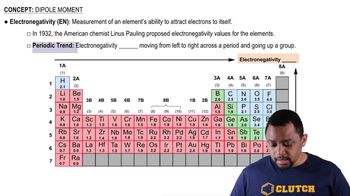
Electronegativity is a measure of an atom's ability to attract and hold onto electrons in a chemical bond. The greater the difference in electronegativity between two bonded atoms, the more polar the bond will be. For example, oxygen is highly electronegative, which influences the polarity of bonds it forms with other elements.
Covalent bonds are formed when two atoms share electrons to achieve a full outer shell, leading to greater stability. The polarity of a covalent bond depends on the difference in electronegativity between the two atoms involved. Bonds can be classified as nonpolar (equal sharing) or polar (unequal sharing) based on this difference.
The polarity of a bond refers to the distribution of electrical charge across the bond. A polar bond occurs when there is a significant difference in electronegativity between the two atoms, resulting in a dipole moment. Understanding the polarity of various bonds is essential for predicting molecular behavior, reactivity, and interactions with other molecules.

 4:48 minuti
 Guida verificata passo dopo passo
 01:51
01:51