What is the osmolarity of the following solutions?
a. 0.35 M KBr
b. 0.15 M glucose + 0.05 M K₂SO₄
Guida verificata passo dopo passo
1
Identify the dissociation of each solute in the solution. For KBr, it dissociates into K⁺ and Br⁻ ions, resulting in 2 particles per formula unit. For glucose, it does not dissociate, so it remains as 1 particle. K₂SO₄ dissociates into 2 K⁺ ions and 1 SO₄²⁻ ion, resulting in 3 particles per formula unit.
Calculate the osmolarity for each solution. For KBr, multiply the molarity by the number of particles: 0.35 M * 2. For glucose, since it does not dissociate, the osmolarity is the same as its molarity: 0.15 M. For K₂SO₄, multiply the molarity by the number of particles: 0.05 M * 3.
Add the osmolarities of the components in the mixed solution. For the solution containing glucose and K₂SO₄, add the osmolarity of glucose to the osmolarity of K₂SO₄.
Express the osmolarity in units of osmoles per liter (osmol/L) for each solution.
Review the concept of osmolarity, which is a measure of the total concentration of solute particles in a solution, taking into account the dissociation of ionic compounds.
Risposta video verificata per un problema simile:
Questa soluzione video è stata consigliata dai nostri tutor come utile per risolvere questo problema.
Durata del video:
2m
Guarda un video:
0 Commenti
Concetti chiave
Ecco i concetti essenziali che devi comprendere per rispondere correttamente alla domanda.
Osmolarity
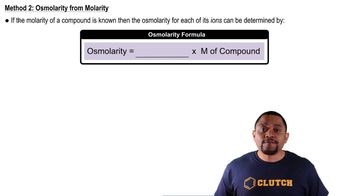
Osmolarity is a measure of the total concentration of solute particles in a solution. It is expressed in osmoles per liter (osmol/L) and accounts for all particles that contribute to the solution's osmotic pressure. For ionic compounds, osmolarity is calculated by considering the number of ions produced when the compound dissociates in solution.
Ionic dissociation refers to the process by which an ionic compound separates into its constituent ions when dissolved in a solvent, typically water. For example, potassium bromide (KBr) dissociates into K⁺ and Br⁻ ions, while potassium sulfate (K₂SO₄) dissociates into 2 K⁺ and SO₄²⁻ ions. This dissociation is crucial for calculating osmolarity, as each ion contributes to the total particle count in the solution.
Electrolytes are substances that dissociate into ions in solution and can conduct electricity, while non-electrolytes do not dissociate and remain as whole molecules. For instance, glucose is a non-electrolyte and does not contribute additional particles to osmolarity, whereas KBr and K₂SO₄ are electrolytes that increase the total particle count due to their dissociation into multiple ions.

 2:47 minuti
 Guida verificata passo dopo passo
 00:37
00:37