Indice
- 1. The Chemical World9m
- 2. Measurement and Problem Solving2h 20m
- 3. Matter and Energy2h 31m
- Classification of Matter18m
- States of Matter9m
- Physical & Chemical Changes20m
- Chemical Properties8m
- Physical Properties5m
- Temperature (Simplified)9m
- Law of Conservation of Mass5m
- Nature of Energy5m
- First Law of Thermodynamics7m
- Endothermic & Exothermic Reactions12m
- Heat Capacity23m
- Thermal Equilibrium (Simplified)10m
- Intensive vs. Extensive Properties13m
- 4. Atoms and Elements2h 37m
- The Atom (Simplified)9m
- Subatomic Particles (Simplified)15m
- Isotopes17m
- Ions (Simplified)22m
- Atomic Mass (Simplified)17m
- Periodic Table: Element Symbols6m
- Periodic Table: Classifications11m
- Periodic Table: Group Names8m
- Periodic Table: Representative Elements & Transition Metals7m
- Periodic Table: Phases (Simplified)9m
- Periodic Table: Main Group Element Charges12m
- Atomic Theory9m
- Rutherford Gold Foil Experiment9m
- 5. Molecules and Compounds1h 51m
- Law of Definite Proportions9m
- Periodic Table: Elemental Forms (Simplified)6m
- Naming Monoatomic Cations7m
- Naming Monoatomic Anions5m
- Polyatomic Ions25m
- Naming Ionic Compounds11m
- Writing Formula Units of Ionic Compounds7m
- Naming Acids18m
- Naming Binary Molecular Compounds6m
- Molecular Models4m
- Calculating Molar Mass9m
- 6. Chemical Composition1h 23m
- 7. Chemical Reactions1h 43m
- 8. Quantities in Chemical Reactions1h 8m
- 9. Electrons in Atoms and the Periodic Table2h 32m
- Wavelength and Frequency (Simplified)6m
- Electromagnetic Spectrum (Simplified)11m
- Bohr Model (Simplified)9m
- Emission Spectrum (Simplified)3m
- Electronic Structure4m
- Electronic Structure: Shells5m
- Electronic Structure: Subshells4m
- Electronic Structure: Orbitals11m
- Electronic Structure: Electron Spin3m
- Electronic Structure: Number of Electrons4m
- The Electron Configuration (Simplified)20m
- The Electron Configuration: Condensed4m
- Ions and the Octet Rule9m
- Valence Electrons of Elements (Simplified)5m
- Periodic Trend: Metallic Character4m
- Periodic Trend: Atomic Radius (Simplified)7m
- Periodic Trend: Ionization Energy (Simplified)9m
- Periodic Trend: Electron Affinity (Simplified)7m
- Electron Arrangements5m
- The Electron Configuration: Exceptions (Simplified)12m
- 10. Chemical Bonding2h 11m
- Lewis Dot Symbols (Simplified)7m
- Ionic Bonding6m
- Covalent Bonds6m
- Lewis Dot Structures: Neutral Compounds (Simplified)8m
- Bonding Preferences7m
- Multiple Bonds4m
- Lewis Dot Structures: Multiple Bonds10m
- Lewis Dot Structures: Ions (Simplified)8m
- Lewis Dot Structures: Exceptions (Simplified)12m
- Resonance Structures (Simplified)5m
- Valence Shell Electron Pair Repulsion Theory (Simplified)4m
- Electron Geometry (Simplified)7m
- Molecular Geometry (Simplified)9m
- Bond Angles (Simplified)11m
- Dipole Moment (Simplified)14m
- Molecular Polarity (Simplified)7m
- 11 Gases2h 17m
- 12. Liquids, Solids, and Intermolecular Forces1h 11m
- 13. Solutions3h 3m
- Solutions6m
- Solutions: Solubility and Intermolecular Forces20m
- Solutions: Mass Percent6m
- Molarity18m
- Osmolarity15m
- Solubility: Temperature Effect8m
- Intro to Henry's Law4m
- Dilutions13m
- Solution Stoichiometry14m
- Molality15m
- The Colligative Properties15m
- Boiling Point Elevation16m
- Freezing Point Depression9m
- Osmosis16m
- 14. Acids and Bases2h 24m
- 15. Chemical Equilibrium1h 27m
- 16. Oxidation and Reduction1h 33m
- 17. Radioactivity and Nuclear Chemistry53m
2. Measurement and Problem Solving
Conversion Factors (Simplified)
Problema 43
Domanda del libro di testo
Why can two conversion factors be written for an equality such as 1 m = 100 cm?
Guida verificata passo dopo passo1
Understand that a conversion factor is a ratio used to express a quantity in different units.
Recognize that the equality 1 m = 100 cm can be expressed as two different conversion factors: \( \frac{1 \text{ m}}{100 \text{ cm}} \) and \( \frac{100 \text{ cm}}{1 \text{ m}} \).
Note that each conversion factor is a fraction that equals 1, allowing you to convert between meters and centimeters without changing the value of a measurement.
Use the conversion factor \( \frac{1 \text{ m}}{100 \text{ cm}} \) to convert from centimeters to meters by multiplying the given value in centimeters by this factor.
Use the conversion factor \( \frac{100 \text{ cm}}{1 \text{ m}} \) to convert from meters to centimeters by multiplying the given value in meters by this factor.
Risposta video verificata per un problema simile:Questa soluzione video è stata consigliata dai nostri tutor come utile per risolvere questo problema.
Durata del video:
37sGuarda un video:
0 Commenti
Concetti chiave
Ecco i concetti essenziali che devi comprendere per rispondere correttamente alla domanda.
Unit Equality
Unit equality refers to the relationship between two different units that represent the same quantity. For example, 1 meter is equal to 100 centimeters, establishing a direct conversion between these two units. This equality allows for the conversion of measurements from one unit to another without changing the actual value of the quantity.
Video consigliato:
Percorso guidato
Pressure Units
Conversion Factors
A conversion factor is a numerical factor used to multiply or divide a quantity when converting from one unit to another. It is derived from unit equalities and can be expressed in two ways. For the equality 1 m = 100 cm, the conversion factors can be written as 100 cm/1 m or 1 m/100 cm, allowing for flexibility in calculations depending on the desired unit.
Video consigliato:
Percorso guidato
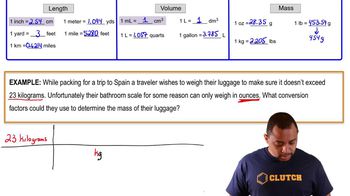
Conversion Factors (Simplified) Example 2
Dimensional Analysis
Dimensional analysis is a mathematical technique used to convert between units by using conversion factors. It involves multiplying the quantity by a conversion factor that cancels out the original unit and introduces the desired unit. This method ensures that the final answer is expressed in the correct units, making it a powerful tool in chemistry and other scientific disciplines.
Video consigliato:
Percorso guidato
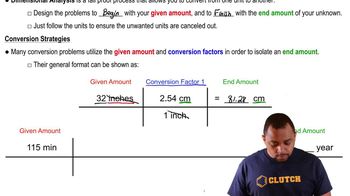
Dimensional Analysis
Video correlati
Pratica correlata
Domanda del libro di testo
Write an equality and two conversion factors for each of the following medications:
a. 10 mg of Atarax per 5 mL of Atarax syrup
2153
views