Skip to main content
Introduction to Chemistry
Il mio corso
Impara
Preparazione agli esami
AI Tutor
Guide di studio
Flashcard
Esplora
Prova l'app
Il mio corso
Impara
Preparazione agli esami
AI Tutor
Guide di studio
Flashcard
Esplora
Prova l'app
Indietro
Acid and Base Strength quiz
Puoi toccare per girare la carta.
What is the main difference between a strong acid and a weak acid in terms of dissociation in water?
Puoi toccare per girare la carta.
👆
What is the main difference between a strong acid and a weak acid in terms of dissociation in water?
A strong acid completely dissociates in water, while a weak acid only partially dissociates.
Avanzamenti del tracciato
I pulsanti di controllo sono stati cambiati in modalità "navigazione".
1/15
Flashcard correlate
Pratica correlata
Video consigliati
Acid and Base Strength definitions
Acid and Base Strength
15 Termini
Acid and Base Strength
14. Acids and Bases
5 Problemi
Argomento
The pH Scale
14. Acids and Bases
5 Problemi
Argomento
14. Acids and Bases
10 Argomenti
30 Problemi
Capitolo
VideoThumbView.guidedCourse
01:46
Acid and Base Strength Concept 4
3121
views
6
rank
VideoThumbView.guidedCourse
00:50
Acid and Base Strength Concept 3
2977
views
7
rank
VideoThumbView.guidedCourse
03:27
Acid and Base Strength Concept 2
3018
views
6
rank
Termini in questo insieme (15)
Nascondere definizioni
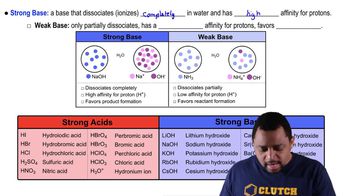
What is the main difference between a strong acid and a weak acid in terms of dissociation in water?
A strong acid completely dissociates in water, while a weak acid only partially dissociates.
What does it mean for an acid or base to be a strong electrolyte?
It means the acid or base fully dissociates into ions in water.
Give an example of a strong acid and describe what happens when it dissolves in water.
Hydrochloric acid (HCl) is a strong acid; it completely dissociates to form H3O+ and Cl- ions.
What is the behavior of a weak acid like hydrocyanic acid (HCN) in water?
HCN only partially dissociates, so most of it remains as HCN in solution.
How do strong bases behave in water?
Strong bases completely dissociate in water, producing OH- ions.
Name a strong base and explain its dissociation in water.
Sodium hydroxide (NaOH) is a strong base; it fully dissociates into Na+ and OH- ions in water.
What is the difference in proton affinity between strong and weak bases?
Strong bases have a high affinity for protons, while weak bases have a low affinity.
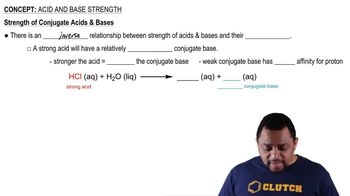
What is the relationship between the strength of an acid and its conjugate base?
There is an inverse relationship: strong acids have weak conjugate bases, and weak acids have stronger conjugate bases.
Why do weak acids have stronger conjugate bases?
Because their conjugate bases have a higher affinity for protons and can more readily accept them.
What does it mean if a reaction arrow points more toward the reactants in an acid-base reaction?
It means the reactants are favored, indicating incomplete ionization typical of weak acids or bases.
List three examples of strong acids.
HCl (hydrochloric acid), HI (hydroiodic acid), and HBr (hydrobromic acid) are strong acids.
Which group of metals forms strong bases when combined with OH-?
Group 1A metals (like Li, Na, K) form strong bases with OH-.
What happens to the concentration of the original acid or base in a strong acid or base solution?
The original acid or base is almost entirely converted to ions, so nearly 0% remains in its original form.
How does a weak base like ammonia (NH3) behave in water?
Ammonia only partially accepts protons, so most of it remains as NH3 in solution.
What is the relationship between the strength of a base and its conjugate acid?
The stronger the base, the weaker its conjugate acid, and vice versa.
 IndietroIndietro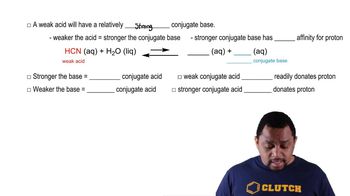
 01:46
01:46