Skip to main content
Introduction to Chemistry
Il mio corso
Impara
Preparazione agli esami
AI Tutor
Guide di studio
Flashcard
Esplora
Prova l'app
Il mio corso
Impara
Preparazione agli esami
AI Tutor
Guide di studio
Flashcard
Esplora
Prova l'app
Indietro
Alpha Decay definitions
Puoi toccare per girare la carta.
Alpha Decay
Puoi toccare per girare la carta.
👆
Alpha Decay
A nuclear process where an unstable nucleus emits a particle identical to a Helium nucleus, resulting in a new element.
Avanzamenti del tracciato
I pulsanti di controllo sono stati cambiati in modalità "navigazione".
1/13
Flashcard correlate
Pratica correlata
Video consigliati
Alpha Decay quiz
Alpha Decay
15 Termini
Alpha Decay
17. Radioactivity and Nuclear Chemistry
5 Problemi
Argomento
Beta Decay
17. Radioactivity and Nuclear Chemistry
5 Problemi
Argomento
17. Radioactivity and Nuclear Chemistry
7 Argomenti
20 Problemi
Capitolo
VideoThumbView.guidedCourse
04:23
Alpha Decay Concept 1
4027
views
27
rank
VideoThumbView.guidedCourse
01:33
Alpha Decay Concept 2
3995
views
21
rank
VideoThumbView.guidedCourse
02:10
Alpha Decay Example 1
3987
views
36
rank
Termini in questo insieme (13)
Nascondere definizioni
Alpha Decay
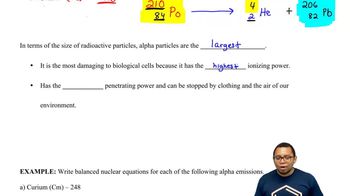
A nuclear process where an unstable nucleus emits a particle identical to a Helium nucleus, resulting in a new element.
Alpha Particle
A cluster of 2 protons and 2 neutrons, matching Helium in atomic mass and number, released during certain radioactive decays.
Helium
An element with atomic mass 4 and atomic number 2, used to symbolize the emitted particle in alpha decay.
Polonium-210
A radioactive isotope with atomic mass 210 and atomic number 84, commonly used to illustrate alpha decay.
Lead-206
The stable element formed after Polonium-210 undergoes alpha decay, with atomic number 82 and mass 206.
Isotope
Atoms of the same element with identical atomic numbers but differing numbers of neutrons, resulting in different masses.
Nuclear Reaction
A transformation counted by changes in atomic nuclei, requiring balanced atomic masses and numbers on both sides.
Atomic Mass
The sum of protons and neutrons in an atom, crucial for balancing nuclear equations.
Atomic Number
The count of protons in an atom, determining the element's identity and used in balancing nuclear reactions.
Ionizing Power
The ability of a particle to damage biological cells by stripping electrons, highest for alpha particles.
Penetrating Power
A measure of how deeply a particle can enter materials; lowest for alpha particles, making them easy to block.
Radioactive Particle
A subatomic entity emitted during nuclear decay, such as alpha, beta, or gamma types, each with unique properties.
Protection
Barriers like clothing or air that prevent radioactive particles, especially alpha particles, from entering the body.
 IndietroIndietro
 04:23
04:23