Skip to main content
Introduction to Chemistry
Il mio corso
Impara
Preparazione agli esami
AI Tutor
Guide di studio
Flashcard
Esplora
Prova l'app
Il mio corso
Impara
Preparazione agli esami
AI Tutor
Guide di studio
Flashcard
Esplora
Prova l'app
Indietro
Atomic, Ionic and Molecular Solids quiz
Puoi toccare per girare la carta.
What is the main difference between crystalline and amorphous solids?
Puoi toccare per girare la carta.
👆
What is the main difference between crystalline and amorphous solids?
Crystalline solids have highly ordered particle arrangements, while amorphous solids have randomly arranged particles with no discernible pattern.
Avanzamenti del tracciato
I pulsanti di controllo sono stati cambiati in modalità "navigazione".
1/15
Flashcard correlate
Pratica correlata
Video consigliati
Atomic, Ionic and Molecular Solids definitions
Atomic, Ionic and Molecular Solids
15 Termini
Atomic, Ionic and Molecular Solids
12. Liquids, Solids, and Intermolecular Forces
5 Problemi
Argomento
Heating and Cooling Curves
12. Liquids, Solids, and Intermolecular Forces
5 Problemi
Argomento
12. Liquids, Solids, and Intermolecular Forces
4 Argomenti
12 Problemi
Capitolo
VideoThumbView.guidedCourse
00:34
Atomic, Ionic and Molecular Solids Example 1
1618
views
7
rank
VideoThumbView.guidedCourse
04:14
Atomic, Ionic and Molecular Solids Concept 1
1916
views
7
rank
Termini in questo insieme (15)
Nascondere definizioni
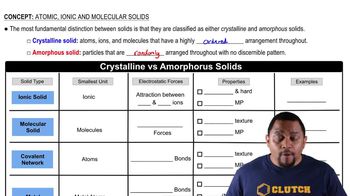
What is the main difference between crystalline and amorphous solids?
Crystalline solids have highly ordered particle arrangements, while amorphous solids have randomly arranged particles with no discernible pattern.
What are the four main types of crystalline solids?
The four main types are ionic solids, molecular solids, covalent network solids, and metals.
What is the smallest unit in an ionic solid?
The smallest unit in an ionic solid is the ion, specifically a cation and an anion.
What type of electrostatic force holds ionic solids together?
Ionic solids are held together by electrostatic attraction between positive and negative ions.
List two properties of ionic solids.
Ionic solids are typically brittle and hard, and they have high melting points.
Give an example of an ionic solid.
A common example of an ionic solid is sodium chloride (NaCl).
What is the smallest unit in a molecular solid?
The smallest unit in a molecular solid is the molecule.
What type of forces hold molecular solids together?
Molecular solids are held together by intermolecular forces.
Describe the texture and melting point of molecular solids.
Molecular solids are generally soft and have low to moderate melting points.
What is an example of a molecular solid?
Ice (solid H2O) is an example of a molecular solid.
What is the smallest unit in a covalent network solid?
The smallest unit in a covalent network solid is the atom.
What are the properties of covalent network solids?
Covalent network solids are very hard and have very high melting points.
Name a common example of a covalent network solid.
Diamond, a form of carbon, is a common example of a covalent network solid.
What is unique about the melting point and flow of amorphous solids?
Amorphous solids do not have a distinct melting point and can flow, which is unusual for solids.
Give two examples of amorphous solids.
Glass and tar are examples of amorphous solids.
 IndietroIndietro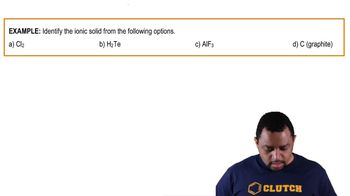
 00:34
00:34