Skip to main content
Introduction to Chemistry
Il mio corso
Impara
Preparazione agli esami
AI Tutor
Guide di studio
Flashcard
Esplora
Prova l'app
Il mio corso
Impara
Preparazione agli esami
AI Tutor
Guide di studio
Flashcard
Esplora
Prova l'app
Indietro
Bohr Model (Simplified) definitions
Puoi toccare per girare la carta.
Bohr Model
Puoi toccare per girare la carta.
👆
Bohr Model
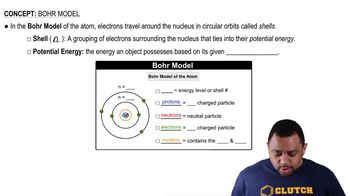
A representation where electrons move in fixed circular paths around a nucleus, each path corresponding to a specific energy level.
Avanzamenti del tracciato
I pulsanti di controllo sono stati cambiati in modalità "navigazione".
1/15
Flashcard correlate
Pratica correlata
Video consigliati
Bohr Model (Simplified) quiz #1
Bohr Model (Simplified)
10 Termini
Bohr Model (Simplified)
9. Electrons in Atoms and the Periodic Table
5 Problemi
Argomento
Emission Spectrum (Simplified)
9. Electrons in Atoms and the Periodic Table
5 Problemi
Argomento
9. Electrons in Atoms and the Periodic Table - Part 3 of 4
12 Argomenti
36 Problemi
Capitolo
VideoThumbView.guidedCourse
03:29
Bohr Model (Simplified) Concept 2
8749
views
65
rank
VideoThumbView.guidedCourse
01:54
Bohr Model (Simplified) Concept 1
3686
views
26
rank
VideoThumbView.guidedCourse
00:41
Bohr Model (Simplified) Example 1
3506
views
22
rank
Termini in questo insieme (15)
Nascondere definizioni
Bohr Model
A representation where electrons move in fixed circular paths around a nucleus, each path corresponding to a specific energy level.
Electron
A negatively charged subatomic particle found in shells around the nucleus, responsible for chemical behavior.
Nucleus
The dense central region of an atom containing protons and neutrons, around which electrons orbit.
Shell
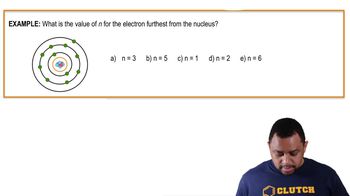
A circular path or energy level where electrons are grouped based on their distance from the nucleus.
n
A variable representing the number of a shell or energy level, with higher values indicating shells farther from the nucleus.
Potential Energy
The stored energy an electron has due to its position within a specific shell relative to the nucleus.
Proton
A positively charged subatomic particle located in the nucleus, contributing to atomic identity.
Neutron
An electrically neutral subatomic particle found in the nucleus, adding to atomic mass but not charge.
Absorption
A process where an electron gains energy from an external source, allowing it to move to a higher shell.
Emission
A process where an electron releases energy and returns to a lower shell, often emitting a photon.
Excited State
A condition where an electron occupies a higher shell after absorbing energy, above its lowest possible energy.
Ground State
The lowest energy configuration of an electron, where it resides in the closest possible shell to the nucleus.
Energy Transition
A change in an electron's energy level as it moves between shells, requiring or releasing specific energy amounts.
Photon
A packet of energy that can be absorbed or emitted by an electron during transitions between shells.
Energy Level
A quantized state associated with a shell, determining the potential energy of electrons within it.
 IndietroIndietro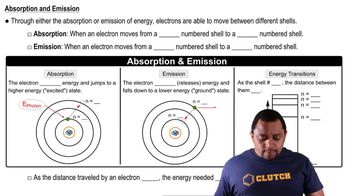
 03:29
03:29