Skip to main content
Introduction to Chemistry
Il mio corso
Impara
Preparazione agli esami
AI Tutor
Guide di studio
Flashcard
Esplora
Prova l'app
Il mio corso
Impara
Preparazione agli esami
AI Tutor
Guide di studio
Flashcard
Esplora
Prova l'app
Indietro
Bond Angles (Simplified) definitions
Puoi toccare per girare la carta.
Bond Angle
Puoi toccare per girare la carta.
👆
Bond Angle
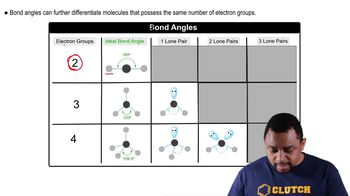
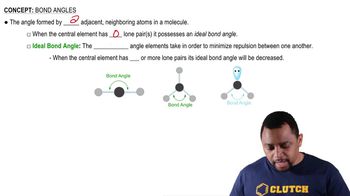
Angle formed by two neighboring atoms with a central atom between them, crucial for determining molecular shape.
Avanzamenti del tracciato
I pulsanti di controllo sono stati cambiati in modalità "navigazione".
1/14
Flashcard correlate
Pratica correlata
Video consigliati
Bond Angles (Simplified) quiz
Bond Angles (Simplified)
15 Termini
Bond Angles (Simplified)
10. Chemical Bonding
5 Problemi
Argomento
Dipole Moment (Simplified)
10. Chemical Bonding
5 Problemi
Argomento
10. Chemical Bonding - Part 1 of 2
12 Argomenti
35 Problemi
Capitolo
10. Chemical Bonding - Part 2 of 2
4 Argomenti
12 Problemi
Capitolo
VideoThumbView.guidedCourse
01:24
Bond Angles (Simplified) Example 1
3420
views
5
rank
VideoThumbView.guidedCourse
02:14
Bond Angles (Simplified) Concept 2
3275
views
7
rank
VideoThumbView.guidedCourse
01:24
Bond Angles (Simplified) Concept 1
3524
views
9
rank
Termini in questo insieme (14)
Nascondere definizioni
Bond Angle
Angle formed by two neighboring atoms with a central atom between them, crucial for determining molecular shape.
Central Atom
Atom in a molecule to which other atoms are bonded, serving as the reference point for measuring angles.
Lone Pair
Non-bonding pair of electrons on the central atom that causes bond angles to decrease from their ideal values.
Ideal Bond Angle
Optimal angle between atoms that minimizes repulsion, occurring when no lone pairs are present on the central atom.
Electron Group
Region of electron density around a central atom, including both bonding pairs and lone pairs.
Repulsion
Force between electron groups that pushes them apart, influencing the size of bond angles.
Bonding Group
Set of electrons shared between the central atom and a surrounding atom, contributing to molecular structure.
Molecular Shape
Three-dimensional arrangement of atoms in a molecule, determined by bond angles and electron groups.
Deviation
Difference between the actual bond angle and the ideal value, typically caused by lone pairs.
180 Degrees
Ideal bond angle for a central atom with two electron groups and no lone pairs, resulting in a linear shape.
120 Degrees
Ideal bond angle for a central atom with three electron groups and no lone pairs, forming a trigonal planar shape.
109.5 Degrees
Ideal bond angle for a central atom with four electron groups and no lone pairs, characteristic of a tetrahedral shape.
Bonding Pair
Pair of electrons shared between two atoms, forming a chemical bond and influencing bond angles.
Surrounding Atom
Atom directly bonded to the central atom, helping define the bond angle in a molecule.
 IndietroIndietro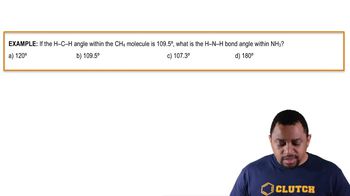
 01:24
01:24