Skip to main content
Introduction to Chemistry
Il mio corso
Impara
Preparazione agli esami
AI Tutor
Guide di studio
Flashcard
Esplora
Prova l'app
Il mio corso
Impara
Preparazione agli esami
AI Tutor
Guide di studio
Flashcard
Esplora
Prova l'app
Indietro
Calculate Oxidation Numbers quiz
Puoi toccare per girare la carta.
What is the oxidation number of an atom in its natural or standard state?
Puoi toccare per girare la carta.
👆
What is the oxidation number of an atom in its natural or standard state?
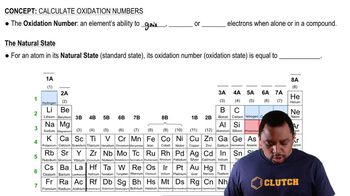
The oxidation number is 0 for an atom in its natural or standard state.
Avanzamenti del tracciato
I pulsanti di controllo sono stati cambiati in modalità "navigazione".
1/15
Flashcard correlate
Pratica correlata
Video consigliati
Calculate Oxidation Numbers definitions
Calculate Oxidation Numbers
15 Termini
Calculate Oxidation Numbers
16. Oxidation and Reduction
5 Problemi
Argomento
Redox Reactions
16. Oxidation and Reduction
5 Problemi
Argomento
16. Oxidation and Reduction
6 Argomenti
15 Problemi
Capitolo
VideoThumbView.guidedCourse
01:22
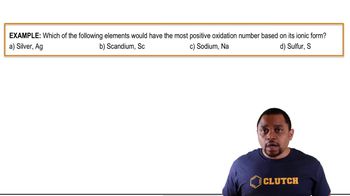
Calculate Oxidation Numbers Example 4
5689
views
63
rank
VideoThumbView.guidedCourse
01:38
Calculate Oxidation Numbers Example 2
6160
views
39
rank
VideoThumbView.guidedCourse
02:42
Calculate Oxidation Numbers
8715
views
84
rank
Termini in questo insieme (15)
Nascondere definizioni
What is the oxidation number of an atom in its natural or standard state?
The oxidation number is 0 for an atom in its natural or standard state.
What is the oxidation number of Group 1A elements when connected to another element?
Group 1A elements have an oxidation number of +1 when connected to any other element.
What is the oxidation number of Group 2A elements in compounds?
Group 2A elements have an oxidation number of +2 in compounds.
What is the oxidation number of fluorine in compounds?
Fluorine has an oxidation number of -1 when connected to any other element.
How does hydrogen's oxidation number change depending on what it is bonded to?
Hydrogen is +1 when bonded to nonmetals and -1 when bonded to metals or boron.
What is the typical oxidation number of oxygen in compounds (excluding peroxides and superoxides)?
Oxygen usually has an oxidation number of -2 in compounds, unless it is in a peroxide or superoxide.
What is the oxidation number of oxygen in peroxides?
In peroxides, oxygen has an oxidation number of -1.
What is the oxidation number of oxygen in superoxides?
In superoxides, oxygen has an oxidation number of -1/2.
What is the oxidation number of Group 7A elements (Cl, Br, I) in compounds?
Group 7A elements have an oxidation number of -1 unless they are connected to oxygen.
What is the oxidation number of a monoatomic ion?
The oxidation number of a monoatomic ion is equal to its charge.
What are cations and anions?
Cations are positive ions and anions are negative ions.
How do you calculate the oxidation number of a non-listed element in a compound?
Treat the unknown element as 'x', use known oxidation numbers, distribute subscripts, and set up an equation equal to the compound's charge.
What are diatomic molecules and which elements form them naturally?
Diatomic molecules are H2, N2, O2, F2, Cl2, Br2, and I2; these elements exist as pairs in their natural state.
In nature, how does phosphorus and sulfur exist?
Phosphorus exists as P4 and sulfur as S8 in their natural states.
Why do oxidation numbers not always correspond to real charges?
Oxidation numbers are a bookkeeping tool and can differ from actual ionic charges, especially in compounds.
 IndietroIndietro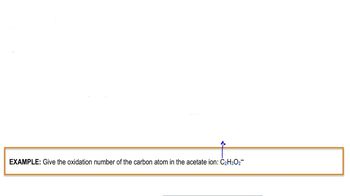
 01:22
01:22