Skip to main content
Introduction to Chemistry
Il mio corso
Impara
Preparazione agli esami
AI Tutor
Guide di studio
Flashcard
Esplora
Prova l'app
Il mio corso
Impara
Preparazione agli esami
AI Tutor
Guide di studio
Flashcard
Esplora
Prova l'app
Indietro
Covalent Bonds definitions
Puoi toccare per girare la carta.
Covalent Bond
Puoi toccare per girare la carta.
👆
Covalent Bond
A connection formed by nonmetals sharing valence electrons to achieve a stable outer shell.
Avanzamenti del tracciato
I pulsanti di controllo sono stati cambiati in modalità "navigazione".
1/15
Flashcard correlate
Pratica correlata
Video consigliati
Covalent Bonds quiz #1
Covalent Bonds
10 Termini
Covalent Bonds
10. Chemical Bonding
5 Problemi
Argomento
Lewis Dot Structures: Neutral Compounds (Simplified)
10. Chemical Bonding
5 Problemi
Argomento
10. Chemical Bonding - Part 1 of 2
12 Argomenti
35 Problemi
Capitolo
10. Chemical Bonding - Part 2 of 2
4 Argomenti
12 Problemi
Capitolo
VideoThumbView.guidedCourse
01:18
Covalent Bonds Example 1
11609
views
104
rank
VideoThumbView.guidedCourse
01:13
Covalent Bonds Example 2
4747
views
53
rank
VideoThumbView.guidedCourse
00:46
Covalent Bonds Concept 3
4930
views
18
rank
Termini in questo insieme (15)
Nascondere definizioni
Covalent Bond
A connection formed by nonmetals sharing valence electrons to achieve a stable outer shell.
Valence Electron
An outermost electron involved in chemical bonding, crucial for ascertaining stability in atoms.
Nonmetal
An element that forms molecular bonds by sharing electrons, typically found on the right side of the periodic table.
Octet Rule
A principle where atoms seek eight electrons in their outer shell to mimic noble gas stability.
Duet Rule
A guideline for hydrogen, which achieves stability with two electrons in its outer shell, like helium.
Noble Gas
An element with a naturally full outer electron shell, serving as a model for electron configuration.
Electron Configuration
The arrangement of electrons in an atom’s shells, determining chemical behavior and stability.
Molecular Compound
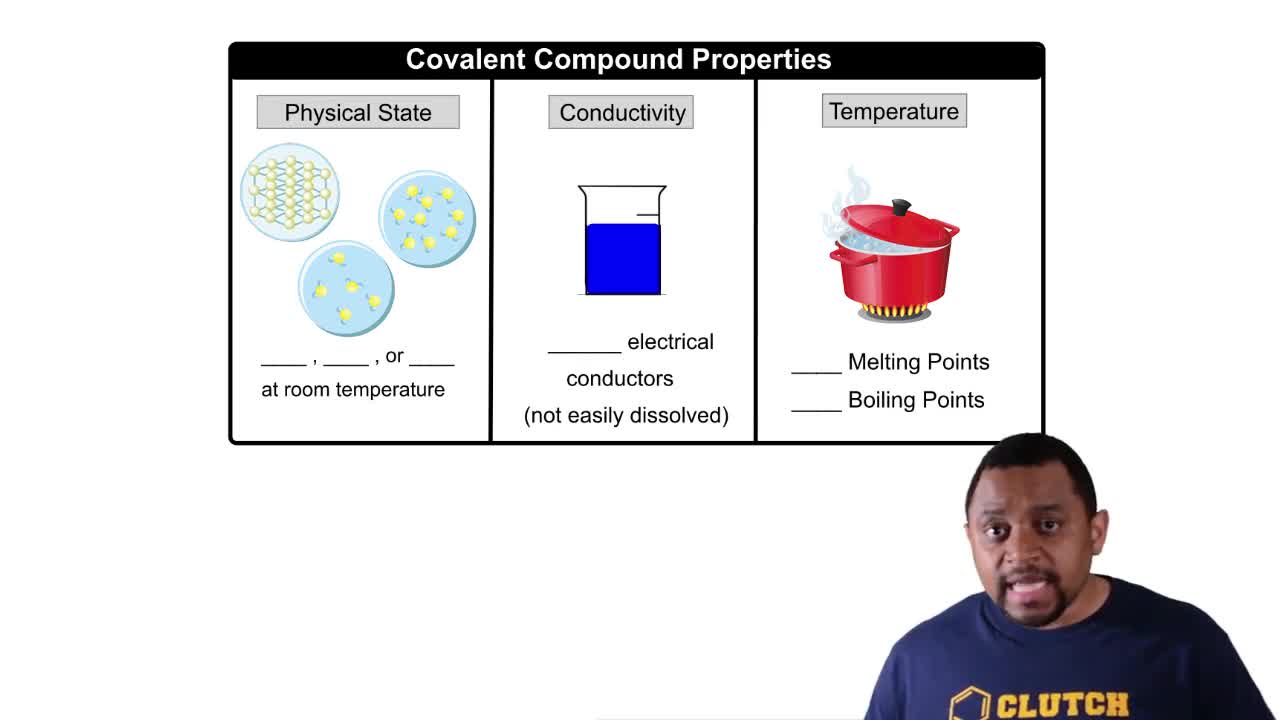
A substance composed of nonmetals bonded by shared electrons, existing as solids, liquids, or gases.
Melting Point
The temperature at which a solid becomes a liquid, typically lower in substances with shared electron bonds.
Boiling Point
The temperature at which a liquid turns to gas, often lower in compounds with shared electron bonds.
Electrical Conductivity
A measure of a substance’s ability to carry electric current, generally poor in compounds with shared electrons.
Electron Shell
A region around an atom’s nucleus where electrons are likely to be found, influencing bonding behavior.
Solvent
A medium, such as water, in which substances may dissolve, affecting conductivity in compounds.
State of Matter
A physical form—solid, liquid, or gas—in which a substance can exist at room temperature.
Neon
A noble gas with a stable electron configuration, often used as a reference for achieving atomic stability.
 IndietroIndietro
 01:18
01:18