Skip to main content
Introduction to Chemistry
Il mio corso
Impara
Preparazione agli esami
AI Tutor
Guide di studio
Flashcard
Esplora
Prova l'app
Il mio corso
Impara
Preparazione agli esami
AI Tutor
Guide di studio
Flashcard
Esplora
Prova l'app
Indietro
Density of Non-Geometric Objects quiz
Puoi toccare per girare la carta.
What method is used to calculate the volume of non-geometric objects?
Puoi toccare per girare la carta.
👆
What method is used to calculate the volume of non-geometric objects?
Water displacement is used to calculate the volume of non-geometric objects.
Avanzamenti del tracciato
I pulsanti di controllo sono stati cambiati in modalità "navigazione".
1/15
Flashcard correlate
Pratica correlata
Video consigliati
Density of Non-Geometric Objects definitions
Density of Non-Geometric Objects
13 Termini
Density of Non-Geometric Objects
2. Measurement and Problem Solving
3 Problemi
Argomento
Density
2. Measurement and Problem Solving
5 Problemi
Argomento
2. Measurement and Problem Solving
10 Argomenti
27 Problemi
Capitolo
VideoThumbView.guidedCourse
01:36
Density of Non-Geometric Objects Concept and Example
8150
views
64
rank
Termini in questo insieme (15)
Nascondere definizioni
What method is used to calculate the volume of non-geometric objects?
Water displacement is used to calculate the volume of non-geometric objects.
What does water displacement measure when an object is submerged?
Water displacement measures the amount of water moved when an object is submerged.
What was the initial water volume in the tube before the object was submerged?
The initial water volume was approximately 3.5 milliliters.
What was the water volume after the object was submerged?
The water volume after submerging the object was approximately 5.8 milliliters.
How do you calculate the volume of a non-geometric object using water displacement?
Subtract the initial water volume from the final water volume after submerging the object.
What is the formula for finding the volume of an object using water displacement?
Volume of object = Final water volume - Initial water volume.
What is the volume of the non-geometric object in the example provided?
The volume of the object is 2.3 milliliters.
Why does the water level rise when a non-geometric object is placed in the tube?
The water level rises because the object displaces water, increasing the volume.
What units are used to measure the volume in the water displacement method?
Milliliters are used to measure the volume.
What is the significance of the difference between the initial and final water volumes?
The difference represents the volume of the non-geometric object.
If the initial water volume is 3.5 mL and the final is 5.8 mL, what is the displaced volume?
The displaced volume is 2.3 milliliters.
What type of objects is water displacement especially useful for measuring?
It is especially useful for measuring non-geometric objects.
What happens to the water level when an object is totally submerged?
The water level increases due to the displacement caused by the object.
How accurate is the water displacement method for measuring volume?
It is accurate for irregularly shaped objects where direct measurement is difficult.
What is the final answer for the volume of the object in the example?
The final answer is 2.3 milliliters.
 IndietroIndietro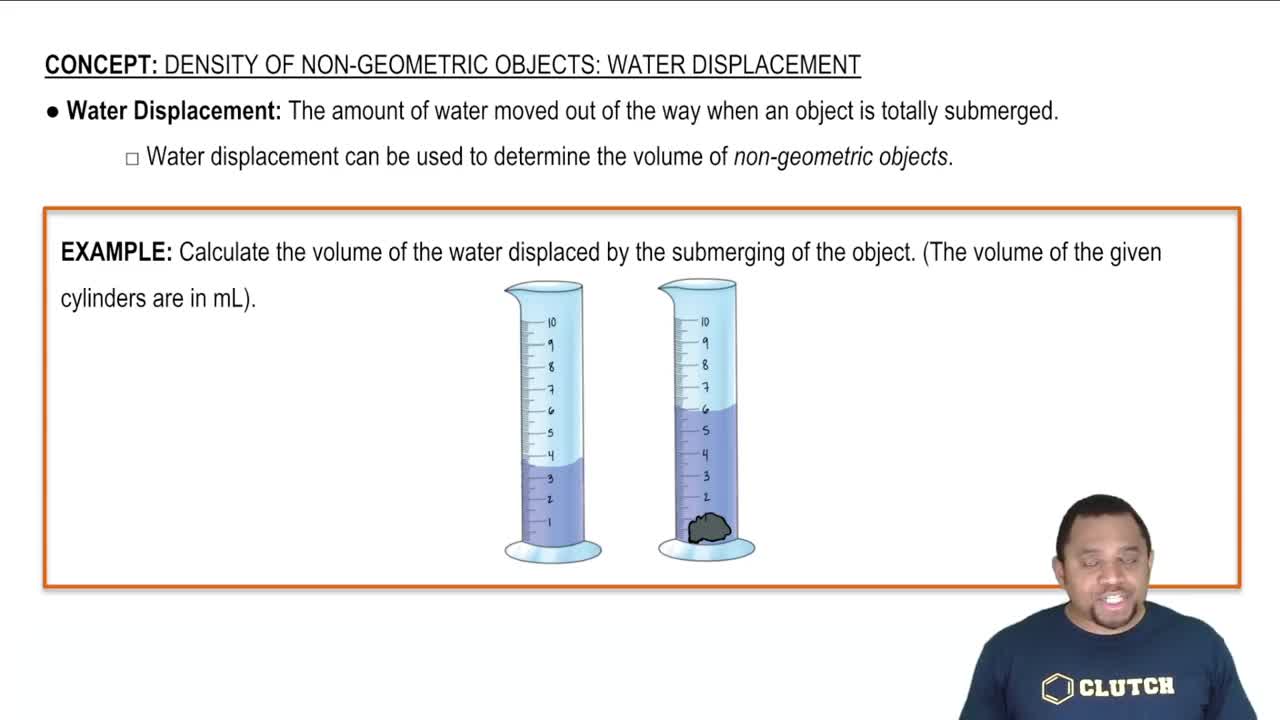
 01:36
01:36