Skip to main content
Introduction to Chemistry
Il mio corso
Impara
Preparazione agli esami
AI Tutor
Guide di studio
Flashcard
Esplora
Prova l'app
Il mio corso
Impara
Preparazione agli esami
AI Tutor
Guide di studio
Flashcard
Esplora
Prova l'app
Indietro
Dipole Moment (Simplified) quiz
Puoi toccare per girare la carta.
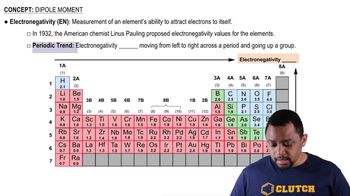
Who proposed the concept of electronegativity in 1932?
Puoi toccare per girare la carta.
👆
Who proposed the concept of electronegativity in 1932?
Linus Pauling, an American chemist, proposed electronegativity values for elements in 1932.
Avanzamenti del tracciato
I pulsanti di controllo sono stati cambiati in modalità "navigazione".
1/15
Flashcard correlate
Pratica correlata
Video consigliati
Dipole Moment (Simplified) definitions
Dipole Moment (Simplified)
15 Termini
Dipole Moment (Simplified)
10. Chemical Bonding
5 Problemi
Argomento
Molecular Polarity (Simplified)
10. Chemical Bonding
5 Problemi
Argomento
10. Chemical Bonding - Part 1 of 2
12 Argomenti
35 Problemi
Capitolo
10. Chemical Bonding - Part 2 of 2
4 Argomenti
12 Problemi
Capitolo
VideoThumbView.guidedCourse
01:07
Dipole Moment (Simplified) Example 3
8616
views
55
rank
VideoThumbView.guidedCourse
01:51
Dipole Moment (Simplified) Concept 1
3734
views
19
rank
VideoThumbView.guidedCourse
01:25
Dipole Moment (Simplified) Concept 2
10659
views
90
rank
Termini in questo insieme (15)
Nascondere definizioni
Who proposed the concept of electronegativity in 1932?
Linus Pauling, an American chemist, proposed electronegativity values for elements in 1932.
What does electronegativity measure?
Electronegativity measures an element's ability to attract electrons to itself.
How does electronegativity change across the periodic table?
Electronegativity increases from left to right across a period and from bottom to top in a group.
Which element is the most electronegative?
Fluorine is the most electronegative element.
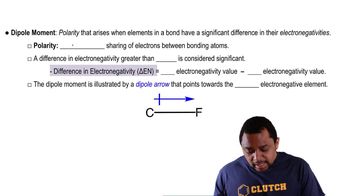
What is the significance of a difference in electronegativity greater than 0.4 between two atoms?
A difference greater than 0.4 is considered significant and results in bond polarity and a dipole moment.
How is the difference in electronegativity (ΔEN) calculated?
ΔEN is calculated by subtracting the lower electronegativity value from the higher one.
What does a dipole arrow represent in a chemical bond?
A dipole arrow represents the direction of electron pull, pointing towards the more electronegative element.
What partial charges are found at each end of a dipole arrow?
The more electronegative end is partially negative (δ−), and the less electronegative end is partially positive (δ+).
What type of bond is formed when the difference in electronegativity is zero?
A pure covalent bond is formed, with equal sharing of electrons and no polarity.
What is the electronegativity difference range for a nonpolar covalent bond?
Nonpolar covalent bonds have a difference between 0.1 and 0.4.
What is the electronegativity difference range for a polar covalent bond?
Polar covalent bonds have a difference between 0.5 and 1.7.
What is the electronegativity difference for an ionic bond?
Ionic bonds have a difference greater than 1.7.
How do charges differ between polar covalent and ionic bonds?
Polar covalent bonds have partial charges, while ionic bonds have full charges.
In a bond between sodium and chlorine, which atom receives the dipole arrow and why?
The dipole arrow points towards chlorine because it is more electronegative than sodium.
How does the magnitude of the dipole arrow change with increasing electronegativity difference?
The dipole arrow becomes larger as the difference in electronegativity increases, indicating greater polarity.
 IndietroIndietro
 01:07
01:07