Skip to main content
Introduction to Chemistry
Il mio corso
Impara
Preparazione agli esami
AI Tutor
Guide di studio
Flashcard
Esplora
Prova l'app
Il mio corso
Impara
Preparazione agli esami
AI Tutor
Guide di studio
Flashcard
Esplora
Prova l'app
Indietro
Empirical Formula quiz
Puoi toccare per girare la carta.
What does the empirical formula of a compound represent?
Puoi toccare per girare la carta.
👆
What does the empirical formula of a compound represent?
The empirical formula represents the simplest whole number ratio of atoms in a compound.
Avanzamenti del tracciato
I pulsanti di controllo sono stati cambiati in modalità "navigazione".
1/15
Flashcard correlate
Pratica correlata
Video consigliati
Empirical Formula definitions
Empirical Formula
12 Termini
Empirical Formula
6. Chemical Composition
5 Problemi
Argomento
Molecular Formula
6. Chemical Composition
5 Problemi
Argomento
6. Chemical Composition
4 Argomenti
12 Problemi
Capitolo
VideoThumbView.guidedCourse
02:26
Empirical Formula
18661
views
364
rank
VideoThumbView.guidedCourse
05:11
Empirical Formula Example 1
6631
views
86
rank
Termini in questo insieme (15)
Nascondere definizioni
What does the empirical formula of a compound represent?
The empirical formula represents the simplest whole number ratio of atoms in a compound.
How does the molecular formula differ from the empirical formula?
The molecular formula shows the actual number of each type of atom in a compound, while the empirical formula shows the simplest ratio.
What is the mole concept used for in chemistry?
The mole concept is used to convert between grams, moles, and units like molecules, ions, or atoms.
How do you derive an empirical formula from a molecular formula?
Divide the subscripts in the molecular formula by their greatest common divisor to get the empirical formula.
What is the empirical formula for C3H6O3?
The empirical formula is CH2O, found by dividing each subscript by 3.
What is the empirical formula for C10H14N2?
The empirical formula is C5H7N, found by dividing each subscript by 2.
When do the empirical and molecular formulas of a compound match?
They match when the subscripts in the molecular formula cannot be reduced further.
Give an example of a compound whose empirical and molecular formulas are the same.
C12H22O11 is an example where the empirical and molecular formulas are the same.
Why must chemical formulas contain whole numbers of each atom?
Because atoms cannot be divided in a chemical formula, so ratios must be whole numbers.
What does the empirical formula tell you about a compound?
It tells you the relative number of atoms of each element in the simplest ratio.
What is the first step in finding an empirical formula from a molecular formula?
Identify the greatest common divisor for all the subscripts in the molecular formula.
If a molecular formula cannot be simplified, what does that mean for its empirical formula?
It means the empirical formula is the same as the molecular formula.
What is the empirical formula for a compound with the molecular formula C2H4?
The empirical formula is CH2, found by dividing each subscript by 2.
Why is understanding the difference between empirical and molecular formulas important?
It helps in identifying the simplest composition of compounds and understanding their chemical properties.
What does the empirical formula CH2O indicate about a compound's composition?
It indicates that for every carbon atom, there are two hydrogens and one oxygen in the simplest ratio.
 IndietroIndietro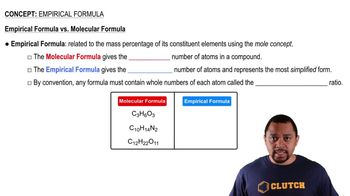
 02:26
02:26