Skip to main content
Introduction to Chemistry
Il mio corso
Impara
Preparazione agli esami
AI Tutor
Guide di studio
Flashcard
Esplora
Prova l'app
Il mio corso
Impara
Preparazione agli esami
AI Tutor
Guide di studio
Flashcard
Esplora
Prova l'app
Indietro
First Law of Thermodynamics quiz
Puoi toccare per girare la carta.
What does the first law of thermodynamics state about energy?
Puoi toccare per girare la carta.
👆
What does the first law of thermodynamics state about energy?
It states that energy cannot be created or destroyed, only transferred between a system and its surroundings.
Avanzamenti del tracciato
I pulsanti di controllo sono stati cambiati in modalità "navigazione".
1/15
Flashcard correlate
Pratica correlata
Video consigliati
First Law of Thermodynamics definitions
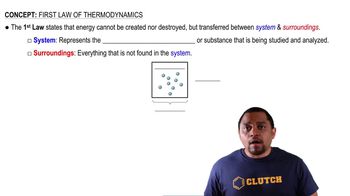
First Law of Thermodynamics
14 Termini
First Law of Thermodynamics
3. Matter and Energy
5 Problemi
Argomento
Endothermic & Exothermic Reactions
3. Matter and Energy
5 Problemi
Argomento
3. Matter and Energy - Part 1 of 2
12 Argomenti
34 Problemi
Capitolo
3. Matter and Energy - Part 2 of 2
1 Argomento
3 Problemi
Capitolo
VideoThumbView.guidedCourse
02:50
First Law of Thermodynamics
10489
views
101
rank
VideoThumbView.guidedCourse
01:18
First Law of Thermodynamics
12268
views
122
rank
2
comments
VideoThumbView.guidedCourse
01:17
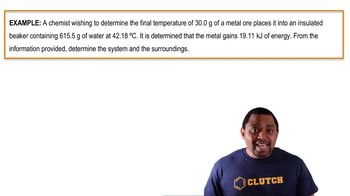
First Law of Thermodynamics Example 1
11208
views
97
rank
Termini in questo insieme (15)
Nascondere definizioni
What does the first law of thermodynamics state about energy?
It states that energy cannot be created or destroyed, only transferred between a system and its surroundings.
In chemistry, what is typically considered the 'system'?
The system is the substance or chemical reaction being studied or analyzed.
What are the 'surroundings' in a thermodynamic context?
The surroundings include everything that is not part of the system, such as the container and the external environment.
What are the two main ways energy can be transferred between a system and its surroundings?
Energy can be transferred as heat (q) or as work (w).
How is heat (q) defined in thermodynamics?
Heat is the flow of thermal energy from a higher temperature object to a lower temperature object.
What does work (w) represent in thermodynamics?
Work is the movement of reacting molecules against gravity or an opposing force.
When is the sign of q (heat) positive for a system?
The sign of q is positive when the system gains, absorbs, or takes in heat.
When is the sign of q (heat) negative for a system?
The sign of q is negative when the system loses, evolves, releases, or gives off heat.
When is the sign of w (work) negative for a system?
The sign of w is negative when the system does work on the surroundings.
When is the sign of w (work) positive for a system?
The sign of w is positive when the surroundings do work on the system.
If gas molecules push up against a piston, what is the sign of w and why?
The sign of w is negative because the system (gas) is doing work on the surroundings (piston).
If a piston is pushed down by an outside force onto gas molecules, what is the sign of w?
The sign of w is positive because the surroundings are doing work on the system.
What happens to energy when it is transferred between system and surroundings?
Energy changes from one form to another but is not created or destroyed.
In the context of heat transfer, which direction does heat naturally flow?
Heat naturally flows from a hotter object to a colder object.
How do you determine the sign of q for a system during a heat transfer?
If the system gains heat, q is positive; if it loses heat, q is negative.
 IndietroIndietro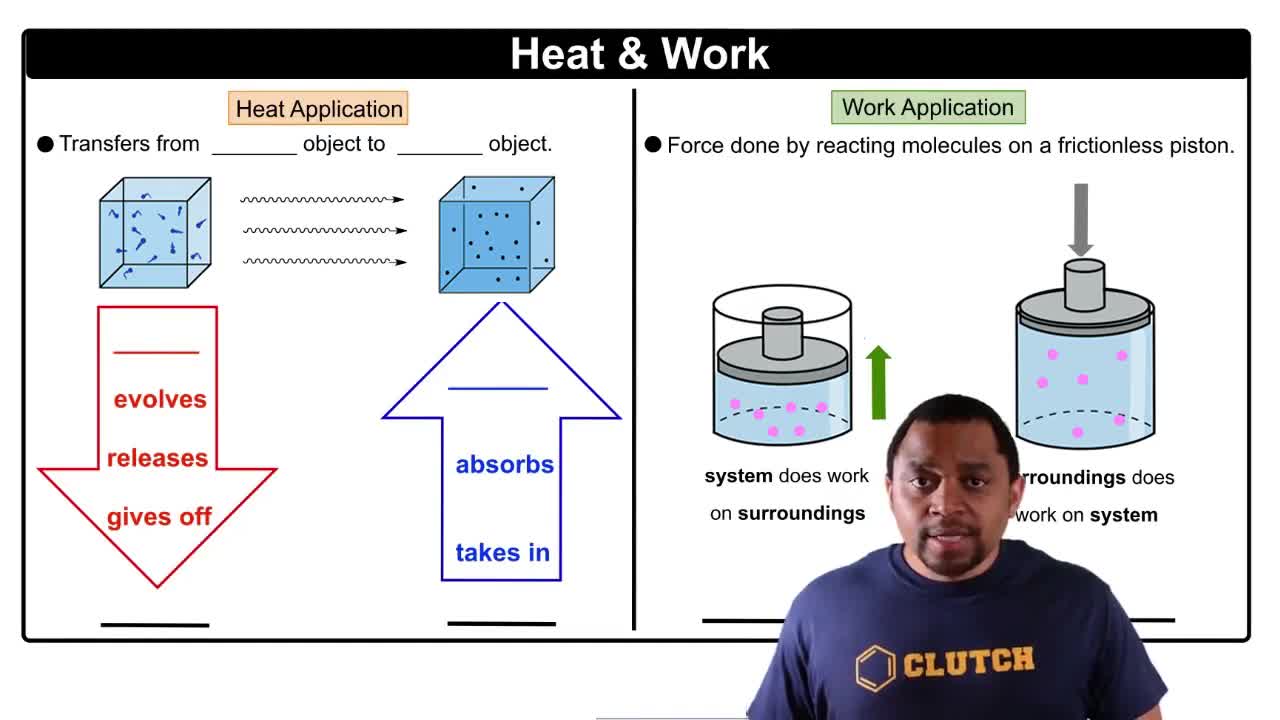
 02:50
02:50